
Summary
Editor's rating
Value for money vs Sony/Bose and other Soundcore models
Looks, buttons, and real‑life handling
Battery life and charging in real use
Comfort for long sessions and everyday use
Build quality, wear over time, and portability
Sound quality, ANC, and call performance
What you actually get and how they’re set up
Pros
- Comfortable fit for long sessions with soft pads and moderate clamping force
- ANC is effective for constant noise and does a decent job reducing voices
- Strong battery life (real‑world ~30–35h with ANC) plus fast charging
- LDAC and app EQ let you dial in a better sound than the default tuning
Cons
- Maximum volume is lower than some competitors and may feel limited
- Mostly plastic build with only a soft pouch, not a hard protective case
- You need firmware updates and app setup (LDAC, EQ) to really get the best out of them
- Some reports of inconsistent unit quality, so buying from a place with easy returns is wise

Specifications
View full product page →| Brand | soundcore |
Mid‑range price, near‑premium features?
I’ve been using the Soundcore Space One for a few weeks now as my main pair of over‑ear headphones, swapping between them and an older Sony WH‑1000XM3 and some Soundcore Liberty 4 NC earbuds. I didn’t go into this expecting miracles – they were on offer, and I mainly wanted something comfortable for work and travel that didn’t cost as much as the latest Sony or Bose. On paper, these tick a lot of boxes: adaptive ANC, LDAC, app control, long battery, multipoint. In real life, it’s a bit more mixed, but overall pretty solid for the price.
The first impression out of the box was positive: they don’t feel cheap, the headband isn’t creaky, and the ear cups rotate enough to sit properly on the head. Pairing was quick with both my Android phone and my laptop. I installed the Soundcore app, did the firmware update to unlock LDAC, and played around with the ANC and EQ for a while before using them in normal day‑to‑day situations: open‑plan office, trains, walking outside, calls, and a few long listening sessions at home.
What stood out quickly is that the ANC and comfort are the main strengths, while the sound is good but not mind‑blowing out of the box. You really need the app to get the most out of them. Also, there seems to be a bit of a lottery in terms of unit quality if I go by other owners’ comments: some people clearly got a weaker‑sounding pair, others (including me with my unit) get a decent, punchy sound once tuned properly.
So if you’re thinking about these as a cheaper alternative to Sony/Bose for commuting, working, or travelling, they’re worth a look, but they’re not perfect. I’ll go through design, comfort, performance, ANC, battery, and value so you can see if the trade‑offs match what you need.
Value for money vs Sony/Bose and other Soundcore models
In terms of value, the Space One sits in a pretty interesting spot. At full price they’re mid‑range, but they’re often discounted, and that’s where they start to look like good value for what you get: solid ANC, decent sound with LDAC, long battery life, and good comfort. If you compare them to top‑tier Sony or Bose, those still win on polish, ANC quality, and overall sound, but they also cost a lot more. For commuting, office work, and casual listening, the Space One covers most of the same use‑cases for noticeably less money.
Compared to other Soundcore products, it’s a bit more nuanced. Their Liberty 4 NC earbuds, for example, sound at least as good and go louder, and the ANC is surprisingly close given they’re earbuds. If you already own those, the Space One mainly brings over‑ear comfort, slightly better passive isolation, and longer battery life, not a huge jump in sound quality. Some users also reported that earlier batches of Space One had weaker sound or quality control issues, while newer batches seem better. So there is a small risk of getting a “meh” unit, though mine has been fine.
If you’re on a strict budget and just want basic ANC, the older Q30/Q35 might be cheaper and still do the job, but the Space One gives you better voice reduction, more polished ANC, and a more modern design. If you’re picky about sound and volume, you might want to buy from somewhere with easy returns, test them for a few days with the app and LDAC, and see if they match your expectations. If they do, you’re getting a lot of headphone for the price; if they don’t, you can step up to Sony/Bose or look at other options.
Overall, I’d call the value strong, especially when on sale, provided you’re okay with a slightly lower max volume and you’re willing to spend 10–15 minutes in the app to tune them. They’re not perfect, but for the mix of comfort, ANC, and features at this price, they hold up well against the competition.
Looks, buttons, and real‑life handling
Design‑wise, the Space One sits in that “clean but not flashy” zone. I tried the Jet Black version, which looks simple and a bit more low‑key than the cream color. The plastic doesn’t scream luxury, but it also doesn’t feel toy‑like. The ear cups rotate about 8° and pivot enough to get a decent seal on different head shapes, which matters a lot for ANC and bass. There’s a bit of metal in the headband that gives it a sturdier feel than super cheap sets.
The physical controls are a mix of buttons and touch. You get real buttons for power, volume, and ANC mode, and some touch controls on the ear cup that you can tweak in the app. Personally, I prefer buttons for the basics, and these are easy enough to find by feel after a day or two. The downside: the layout isn’t instantly obvious, so the first few times you will press the wrong thing when trying to change track or ANC. After a week, my muscle memory caught up and it stopped being an issue.
One thing I liked is that they don’t clamp too aggressively, and they don’t squeak when you adjust them. I’ve had cheaper over‑ears where every adjustment made plastic noises; here it’s reasonably solid. They don’t fold into a tight ball though, only flat, so they take up a bit more space in a bag than, say, some travel‑focused models. If you travel light, that’s something to keep in mind.
In terms of looks, they’re fine – nothing that screams high fashion, but also nothing that looks cheap or childish. If you want something discreet for an office or train, these are neutral enough. If you’re expecting premium metal and leather, this isn’t that. From a practical point of view though, the design gets the job done: they’re easy to wear, easy to adjust, and the controls are functional once you get used to them.
Battery life and charging in real use
On paper, Soundcore promises up to 40 hours with ANC on and 55 hours with ANC off. In real life, with ANC on most of the time, LDAC active, and volume around 60–70%, I was seeing roughly 4–5 full workdays (around 7–8 hours each) before needing a charge. So I’d say somewhere in the 30–35 hour range with my usage, which is still quite good. If you mainly use SBC/AAC instead of LDAC and slightly lower volume, hitting close to the claimed 40 hours with ANC on seems realistic.
Charging is via USB‑C, and they support fast charging: a short 5–10 minute top‑up gets you a few hours of use, which saved me once when I forgot to charge before a train trip. A full charge from low took roughly 2 hours on my regular USB‑C charger. There’s no wireless charging, but honestly, I don’t expect that at this price and it’s not something I miss on over‑ear headphones.
The battery indicator in the app is handy because the LED on the headphones only gives you a rough idea. The app shows percentage, so you can see if you’ve got enough juice for a flight or a full day at work. I didn’t notice any weird battery drain in standby; they hold their charge fine if you forget them in a bag for a few days. Auto power‑off settings in the app help too, so they don’t sit there slowly draining if you leave them on a desk.
Overall, battery life is one of the least problematic parts of these headphones. They last long enough that you’re not constantly thinking about the charger, and the fast top‑up feature is genuinely useful. If you commute, work with them on, and maybe travel occasionally, they’ll comfortably cover that without turning into another device you have to charge every single night.

Comfort for long sessions and everyday use
Comfort is honestly one of the better points here. I wore these for multiple 2–3 hour sessions at my desk and on a couple of long train rides, and I didn’t get that “get these things off my head” feeling that some tighter headphones give. The clamping force is moderate: strong enough to keep a seal when you move your head, but not so strong that your jaw aches. If you wear glasses, the pads do press a bit against the arms, but for me it was manageable even over longer stretches.
The ear pads are soft and reasonably deep; my ears didn’t touch the drivers unless I pushed the cups in on purpose. They sit fully over the ear rather than on it (despite the “on ear” wording in some specs), which is what you want for ANC and comfort. The headband has enough padding that I didn’t get a hot spot on the top of my head, even when I was wearing them for an entire afternoon of calls and music. Weight‑wise, they’re light enough that you forget them a bit after a while, especially compared to older, heavier ANC models.
Heat build‑up is there, like with any over‑ear, but not worse than average. After about an hour, my ears were warm but not sweaty, and I could easily go a couple of hours before needing a break. For people very sensitive to heat, no over‑ear will be perfect, but these are in the “pretty normal” range. The rotating cups do help get a decent fit so you don’t have to overtighten the headband.
Overall, if you’re planning to use these for commuting, working in an office, or long flights, comfort is a strong reason to consider them. They’re not feather‑light or luxury materials, but the shape, padding, and weight balance are well thought‑out. I’d put them a notch below top‑tier Sony/Bose in feel, but clearly above the random budget stuff and a lot of older models.
Build quality, wear over time, and portability
Build quality is decent for the price, but you can tell they’re mostly plastic. The headband has a metal core which helps with flex, and I didn’t feel like they’d snap from normal use. I tossed them into a backpack (inside the soft pouch) a few times, and they came out without any visible marks. The joints and hinges haven’t started creaking yet after regular daily use, which is a good sign, but I wouldn’t abuse them like a rugged headset either.
The carrying pouch is made from a synthetic, slightly water‑resistant fabric. It keeps dust and light rain off, but it’s not a hard case. If you’re used to premium ANC headphones that come with a structured case, this will feel like a downgrade. I’d say the pouch is adequate if your bag isn’t overstuffed or if you don’t sit on it by accident. If you travel a lot and want more protection, you might want to buy a third‑party hard case.
Water resistance is rated as “water resistant” but not truly waterproof. I would treat them as “okay for light drizzle and sweaty commutes, not okay for heavy rain or gym showers”. The synthetic ear pads will probably hold up fine if you wipe them down now and then, but like any pads, they’ll likely flatten a bit over a year or two of heavy use. Replacement pads aren’t as easy to find as for the big brands yet, which is something to keep in mind if you’re planning to keep them long‑term.
From a durability perspective, I’d say they feel like a solid mid‑range product: better than budget no‑name stuff, but not built like a tank. If you treat your gear reasonably well – use the pouch, don’t twist the headband for fun, keep them dry – they should hold up fine. If you’re rough on your headphones or constantly throw them in a bag with heavy items, I’d be a bit more careful or get a hard case to be safe.
Sound quality, ANC, and call performance
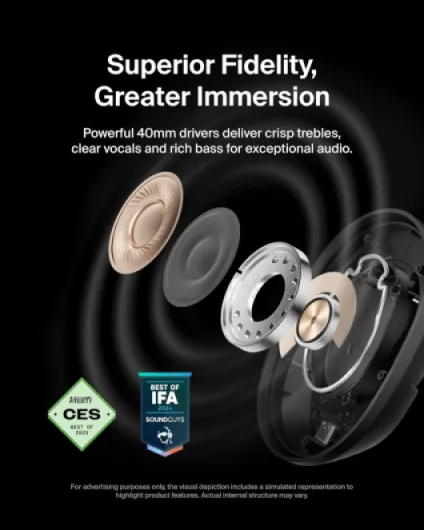
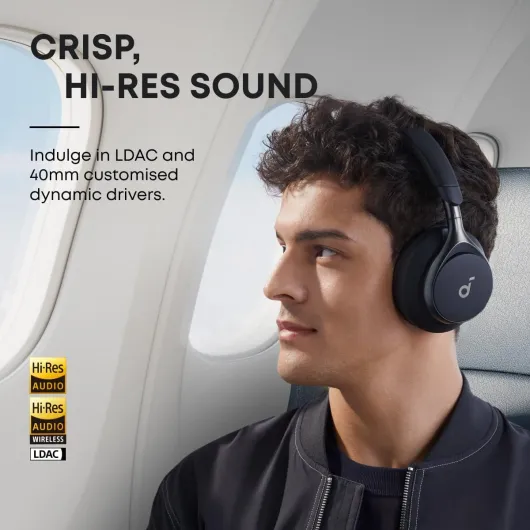
Let’s talk sound first. Out of the box, the Space One sounds decent but a bit safe: the tuning is fairly balanced with a slight bass emphasis, but it can feel a little flat and not very loud compared to some competitors. Once I turned on LDAC and used a custom EQ in the app, things improved quite a bit. Bass has good punch without turning into a muddy mess, mids are clear enough for vocals and podcasts, and highs are present without getting harsh. It’s not audiophile territory, but for Spotify, YouTube, and Netflix, it’s more than fine.
Volume is where some people might be annoyed. Compared to my Soundcore Liberty 4 NC earbuds and my Beats over‑ears, these don’t go as loud at the same phone volume. On Android, I had to push the volume almost to the top to get the same feeling I get at maybe 70–80% on other devices. You can work around this a bit with EQ or a preamp in apps like Poweramp, but then you start getting the hearing safety warnings. If you like listening very loud, you might find these a bit restrained.
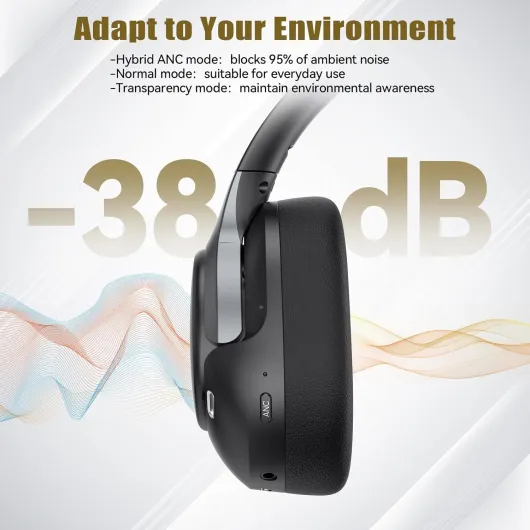
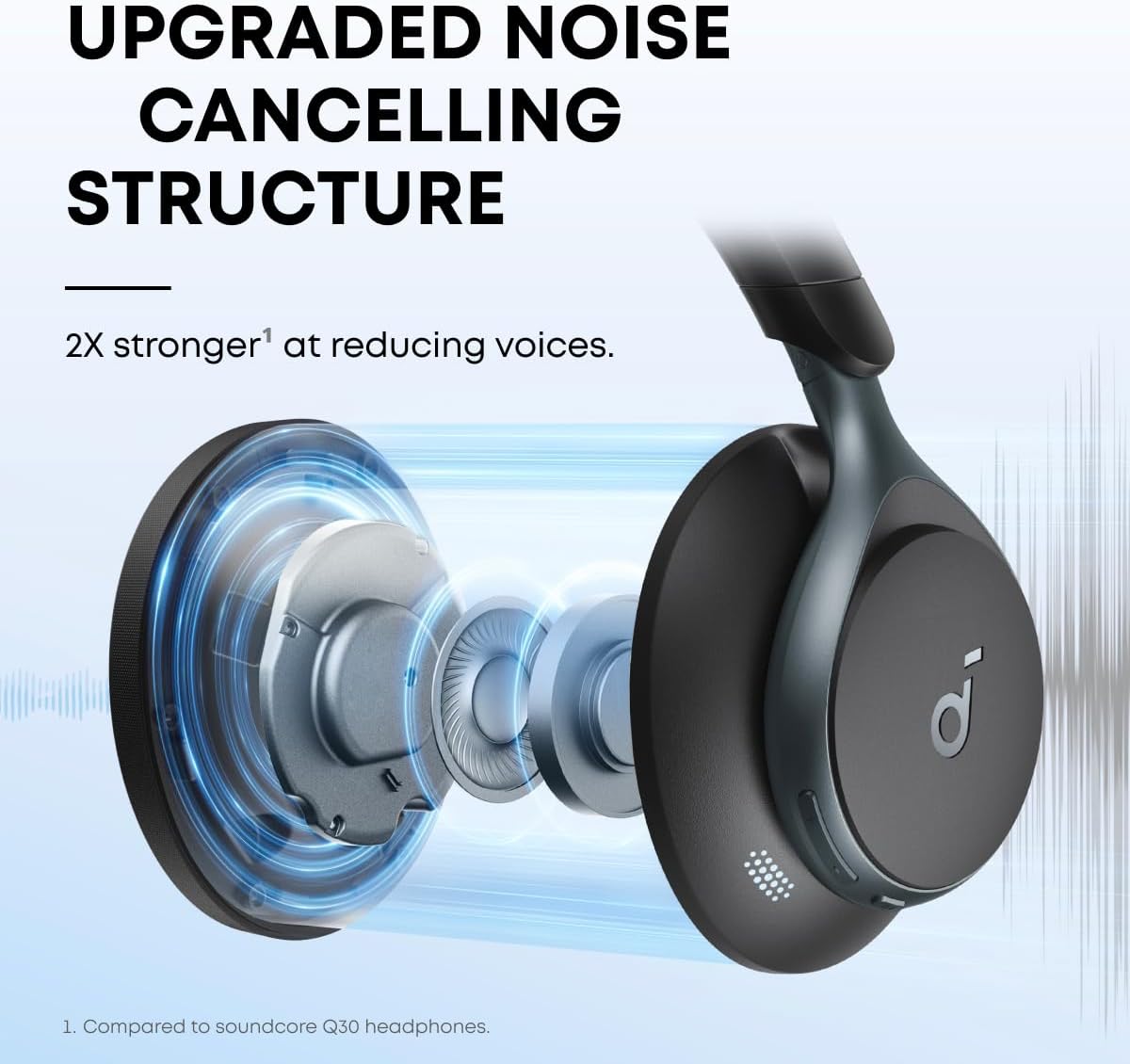
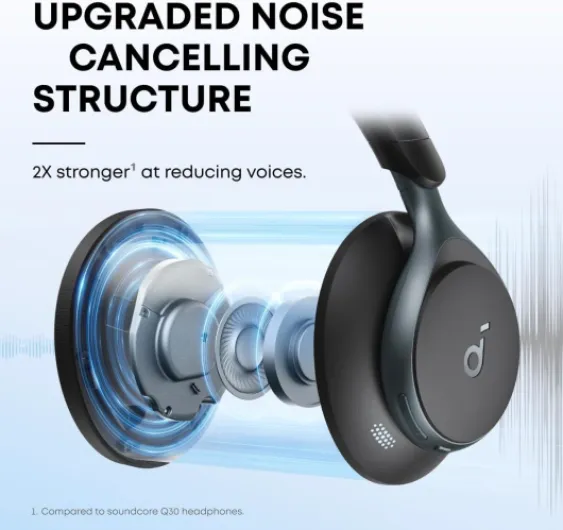
ANC is solid for the price. Soundcore claims up to 98% noise reduction and “2x stronger voice reduction” vs their Q30, and while I’m not measuring that with lab gear, in real life they do a good job with constant low‑frequency noise (train rumble, aircon, road noise) and a decent job reducing voices. Voices don’t vanish completely, but they’re pushed into the background enough that you can focus on music or an audiobook. In a noisy office and on a busy train, I was comfortable listening at moderate volume without cranking it. There’s also a wind reduction mode that actually helps when walking outside; it doesn’t kill wind noise totally but it’s less whooshy than on some other ANC sets.
For calls, the microphones are fine but not spectacular. People could hear me clearly indoors and in a car, but in a very noisy street, some background noise still came through. It’s good enough for work calls and quick chats, just not a replacement for a dedicated office headset in really loud environments. Overall, performance is pretty solid for the price bracket, with the main caveat being the not‑so‑high maximum volume and the fact that you really want to use LDAC + EQ to get the best sound.
What you actually get and how they’re set up
In the box you get the Space One headphones, a soft waterproof pouch (not a hard case), a USB‑C charging cable, and a 3.5 mm audio cable. No fancy extras. The pouch is fine for a backpack, but if you throw your bag around a lot, just know it’s not rigid protection. The headphones themselves fold flat but not into a really compact ball like some models, so they’re more of a “flat in the laptop sleeve” kind of pair than something that tucks into a tiny bag pocket.
Setup is straightforward. Hold the power button, they pop up in Bluetooth, connect, done. I tested on Android and Windows; both were painless. To get LDAC (the higher‑quality Bluetooth codec), you have to use the Soundcore app and update the firmware, then enable LDAC in the app and, on Android, confirm you allow LDAC in Bluetooth settings. If you skip that, you’re just on standard SBC/AAC and you’re not hearing their full potential. It’s a bit of faff the first time, but once it’s set, it stays.
The app is actually important here. Without it, you get a very generic sound and basic ANC. With it, you can tweak the EQ, turn on adaptive ANC, adjust noise reduction levels, and set up wear detection, Easy Chat, and button shortcuts. I ended up using a custom EQ because the default profile felt a bit too safe and flat for my taste. The good thing is you can save different profiles for music, podcasts, and calls.
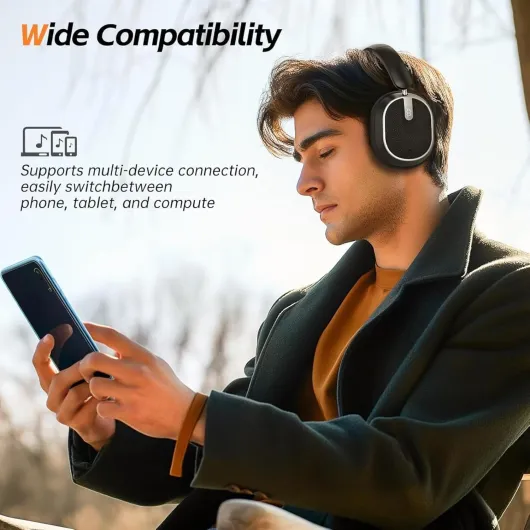
In daily use, they connect pretty quickly when you power them on, and multipoint (phone + laptop) works reasonably well. There’s a slight delay sometimes when switching audio sources, but nothing dramatic. Calls come through clearly enough, and the headphones automatically pause when you take them off if you enable that in the app. Overall, from a usability point of view, they behave like a modern mid‑range ANC headphone should – no big surprises, just make sure you actually use the app or you’re leaving half the features on the table.
Pros
- Comfortable fit for long sessions with soft pads and moderate clamping force
- ANC is effective for constant noise and does a decent job reducing voices
- Strong battery life (real‑world ~30–35h with ANC) plus fast charging
- LDAC and app EQ let you dial in a better sound than the default tuning
Cons
- Maximum volume is lower than some competitors and may feel limited
- Mostly plastic build with only a soft pouch, not a hard protective case
- You need firmware updates and app setup (LDAC, EQ) to really get the best out of them
- Some reports of inconsistent unit quality, so buying from a place with easy returns is wise
Conclusion
Editor's rating
The Soundcore Space One is a solid mid‑range ANC headphone that does most things well without trying to pretend it’s a top‑tier luxury product. The big wins are comfort, battery life, and generally effective ANC, especially for constant background noise and a good chunk of human voices. With LDAC and some EQ tweaking, the sound is enjoyable for everyday music, movies, and podcasts, even if it doesn’t blow your mind. The main downside is the relatively modest maximum volume and the fact that you really need the app and firmware updates to get the best experience.
They make the most sense if you want comfortable over‑ear headphones for commuting, office work, studying, or travel, and you don’t feel like paying Sony/Bose prices. If you already own good Soundcore earbuds like the Liberty 4 NC, this is more of a comfort and battery upgrade than a huge sound upgrade. If you’re very picky about sound or want very loud playback, you might be happier saving up for something higher‑end or at least buying these with the option to return if they don’t suit you.
Overall, I’d say they’re good value when discounted, with a few quirks but no major deal‑breakers for most people. If you’re okay with the trade‑offs and use the app properly, they get the job done and then some for everyday use.