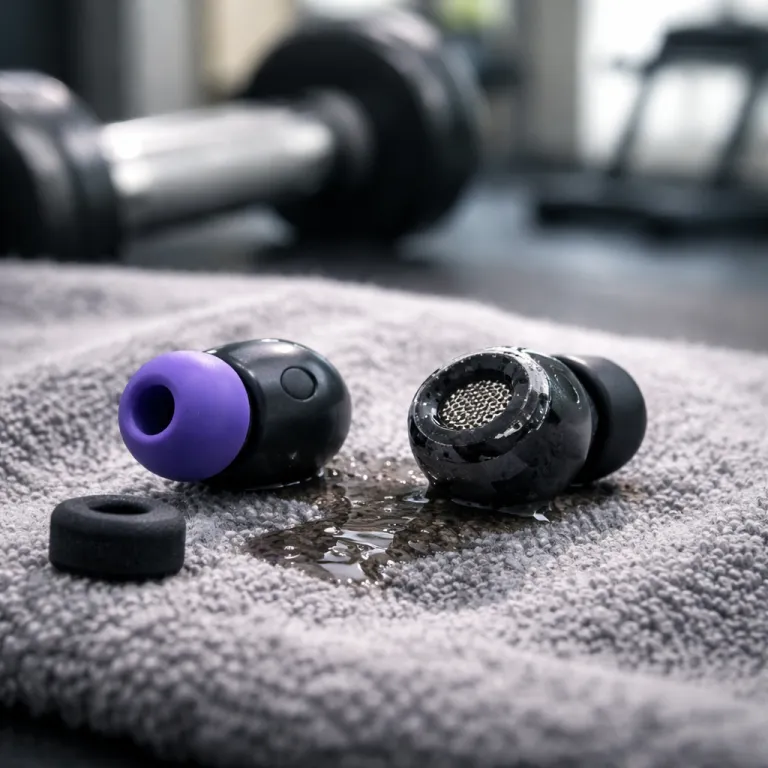
Why workout earbuds noise cancelling fails once you start sweating
Active noise cancellation in workout earbuds depends on a tiny sealed air cavity in your ear. When sweat pools between the ear tip and your ear canal, that seal loosens, the internal pressure changes, and the microphones that drive active noise reduction start cancelling the wrong frequencies. You still hear the music from your wireless earbuds, but the low frequency noise from treadmills and air conditioning suddenly leaks back in.
Think of the ear tip as a gasket; if it shifts even a millimetre during active sport movement, the anti noise waveform no longer mirrors the incoming gym noise. Even a modest leak can noticeably reduce low frequency attenuation, which is the difference between a dull rumble and a clearly audible thud. That is why the same pair of true wireless earbuds can feel pro level on the subway yet only standard at the squat rack, even when the app still shows ANC active at maximum strength.
Foam tips expand to fill the ear and initially give very good passive isolation, so the sound quality and perceived cancellation depth feel impressive during warm up sets. After 30 to 40 minutes of heavy sweat, that foam absorbs moisture, softens, and the earbuds start to slip, which weakens both passive and active noise control at once. Silicone tips do not soak up sweat, but they rely more on exact ear geometry, so some listeners never get a secure stay place fit and end up blaming the headphones instead of the physics.
For gym use, the best workout earbuds noise cancelling setups combine a slightly tacky silicone tip with stabilising ear hooks or wings that lock against the outer ear. This keeps the wireless earbud in a consistent position so the microphones that drive active noise can predict the incoming noise field more accurately. Without that mechanical stability, even premium pro models with sophisticated ANC algorithms will sound good only for the first few sets before the seal fails and the noise cancelling collapses.
Urban commuters who run to the train face a double test, because wind noise and sweat hit the microphones and the ear tip seal simultaneously. In that scenario, open ear designs that let you stay aware of traffic can paradoxically feel more consistent than half broken ANC, since you are no longer expecting full silence. The key is matching the features product list on the box to the real acoustic environment you face between the locker room, the weight floor, and the platform edge.
IP ratings, sweat, and what water resistance really means in the gym
Marketing for workout earbuds noise cancelling often leans heavily on IP ratings, but those numbers describe water resistance, not whether ANC will keep working after an hour of burpees. An IPX4 rating on wireless earbuds means protection from splashes of water from any direction, which covers sweat dripping off your forehead but not a direct jet from a shower or tap. IPX5 raises that to low pressure jets, while IP67 adds dust protection and short immersion, yet none of these standards guarantee that the ear tip seal will survive a soaked spin class.
In practice, IP ratings protect the internal electronics and the battery from corrosion, so your headphones keep turning on and pairing over Bluetooth even after hundreds of sessions. They do not stop sweat from lubricating the silicone interface between the ear tip and your skin, which is where the real battle for stable noise cancellation happens. That is why a mid range pair with IPX4 and a smart mechanical design can outperform a more expensive pro model with IPX7 if the cheaper one uses better ear hooks and a more secure fit.
Open ear sport models such as bone conduction headphones sidestep the seal problem entirely, because they never attempt deep noise cancellation in the first place. You trade full ANC for the ability to stay aware of bikes and traffic while still hearing podcasts at a reasonable sound level, which many runners consider a good safety compromise. For commuters who lift before work, an open ear design can also avoid the pressure build up that some people feel when ANC active modes fight against heavy breathing.
Some brands blur the lines with hybrid designs that offer both open ear and sealed ANC modes in one features product package. A dual form approach lets you use a more standard true wireless seal on the train, then switch to a looser, safer fit for outdoor intervals where you must stay aware of your surroundings. When you read full spec sheets, focus less on the IP code and more on how the manufacturer describes the mechanical stabilisers that keep the earbuds anchored during lateral movement.
Price often climbs with higher IP ratings, but the relationship between price and real gym durability is not linear. A well tuned mid price pair with IPX5, a solid charging case, and replaceable silicone tips can deliver better long term value than a premium IP67 model that never quite fits your ear. If you want a deeper technical breakdown of how budget friendly wireless earbuds balance water resistance, ANC, and sound quality, a detailed guide on choosing the best wireless budget earphones for serious noise canceling provides a useful framework for comparing options.
Ear tips, foam versus silicone, and why seals fail mid set
The ear tip is the unsung hero of workout earbuds noise cancelling, because it controls both comfort and the acoustic seal that ANC algorithms rely on. Foam tips behave like memory pillows for your ear canal, expanding to fill gaps and delivering excellent passive isolation that makes even modest active noise cancellation sound stronger. The downside is that foam absorbs sweat and skin oils, which gradually change its shape and friction, so the once perfect fit can loosen halfway through a heavy circuit.
Silicone tips, by contrast, repel moisture and keep their shape, which helps maintain a more consistent seal during long active sport sessions. They tend to transmit more structure borne noise from jaw movement and cable taps, but they do not collapse under sweat, so the microphones that drive active noise can keep predicting the incoming sound field with fewer surprises. For commuters who also train, a mixed kit of foam and silicone tips lets you choose maximum isolation for the train and more stable silicone for the gym floor.
Hybrid tips try to combine the best of both materials, using a silicone outer shell with a foam core to balance comfort, grip, and sound quality. These can work well with true wireless earbuds that already have a secure housing shape, but they still degrade over time and need regular replacement to keep ANC performance near factory standard. Ignoring tip maintenance is one reason people think their headphones have aged badly, when in reality the electronics and battery life remain fine but the mechanical seal has quietly disappeared.
Some audiophile in ear monitors, such as those examined in an in depth analysis of how a single driver IEM reshapes noise canceling expectations, show how much performance depends on tip geometry rather than just drivers. The same principle applies to mainstream wireless earbuds from brands sold on Amazon, where a small change in nozzle angle or tip flange thickness can make the difference between a good gym fit and constant readjustment. If your earbuds feel like they never stay place during burpees, experiment with third party tips before assuming the ANC is weak.
Remember that every ear is asymmetric, so you may need a different tip size for each ear to get balanced sound and stable noise cancelling. Many pro models quietly support this, even if the quick start guide only shows a symmetric setup, so take the time to test each size individually. Once you lock in a secure fit, the combination of passive isolation and active noise cancellation will finally match the marketing claims, at least until sweat and wear slowly shift the equation again.
Open ear alternatives and when giving up ANC is the smarter move
Not every workout earbuds noise cancelling scenario actually benefits from maximum isolation, especially in busy urban environments where you must stay aware of traffic. Open ear designs that rest outside the ear canal or use bone conduction avoid the sealed cavity problem entirely, so sweat cannot break a seal that never existed. You lose deep low frequency noise canceling, but you gain consistent sound and situational awareness that does not change as your heart rate climbs.
Models such as Shokz and other open ear sport headphones sit on the cheekbones or just above the ear, leaving the canal open so external sound mixes naturally with your music. This approach keeps your perception of the environment stable, which many runners and cyclists prefer to the on off feeling of ANC active modes that struggle once sweat hits the microphones. For commuters who jog to the station, an open ear pair can complement a more isolating true wireless set used later on the train.
Some newer designs experiment with semi open architectures that let a controlled amount of noise in while still using limited active noise cancellation to tame constant hum. These hybrids aim to balance safety and focus, allowing you to stay aware of announcements while reducing the low frequency roar of treadmills and ventilation systems. The trade off is that you will never get the same library quiet silence as a fully sealed in ear, but you also avoid the sudden collapse in performance when sweat breaks the seal.
For people who feel pressure or discomfort from deep sealing ear tips, open ear or shallow fit earbuds can be a better long term choice even if the spec sheet looks less impressive. The features product list might emphasise water resistance, secure ear hooks, and stable Bluetooth connection over headline ANC numbers, yet those qualities matter more when you are actually moving. In many cases, a reliable, comfortable open ear design with predictable sound quality beats a temperamental pro ANC model that only shines in a dry, air conditioned office.
When comparing price across options, think in terms of use cases rather than raw features. A mid price open ear pair for outdoor runs plus a separate set of sealed wireless earbuds for commuting can cost less than one flagship ANC model, while covering more scenarios with better overall comfort. The real luxury is not a single pair that claims to do everything, but a setup that keeps working predictably whether you are under a barbell or under a winter hat on the platform.
Real world ANC performance in the gym and how to maintain it
Workout earbuds noise cancelling performance in the gym depends as much on maintenance as on the original engineering. Sweat, skin oils, and dust gradually clog the tiny microphone ports that ANC systems use to sample external noise, which reduces their ability to generate accurate anti noise. A quick wipe after every session and a deeper clean of the ear tips and grilles each week can preserve both sound quality and effective noise cancellation far longer than most people expect.
Battery health also plays a quiet role, because ANC and Bluetooth radios draw significant power, especially in compact true wireless designs. As the battery ages and its capacity shrinks, some headphones automatically reduce ANC strength or transparency features to stretch battery life, which you may perceive as weaker noise canceling during long active sport sessions. Storing your wireless earbuds in their charging case when not in use, and avoiding full discharges, helps keep the battery closer to its original standard for more gym seasons.
Different models handle sweat and motion very differently, even at similar price points. Independent measurements on popular ANC earbuds often show strong reduction at low frequencies in a static test rig, but that advantage can drop sharply once the seal shifts during running or burpees. Sport focused designs with ear hooks and grippier shells keep the earbuds locked in place so the algorithms can work, while more minimal commuter models may struggle when lateral head movement and sweat combine.
When you read full reviews, pay close attention to comments about fit stability, water resistance, and how often testers had to reseat the earbuds during intervals. A model that measures slightly worse in lab based ANC depth but barely moves in the ear during burpees will usually feel better in real life than a benchmark champion that slips every few minutes. For a deeper dive into how miniature drivers and enclosure design affect perceived ANC and overall sound, a detailed exploration of miniature planar IEMs offers useful context even if you never plan to buy audiophile gear.
Ultimately, the best workout earbuds noise cancelling setup is the one that stays predictable from warm up to cooldown. That means a secure mechanical fit with or without ear hooks, a realistic IP rating for your sweat level, and a maintenance routine that keeps microphones and tips clean. Silence in the gym is not about the dB rating on the box, but about how much of the clank and chatter disappears when your heart rate is highest.
FAQ
Why do my ANC earbuds sound worse halfway through a workout ?
As you sweat, moisture reduces friction between the ear tip and your skin, so the earbuds slowly lose their seal and shift position. Active noise cancellation relies on a stable sealed cavity, so even a small movement changes the acoustics and weakens the anti noise signal. Cleaning your ears, switching to silicone tips, or using ear hooks can help the earbuds stay place longer.
Is a higher IP rating always better for gym headphones ?
A higher IP rating means better protection against water and dust, but it does not guarantee a better fit or stronger ANC. For most indoor workouts, IPX4 or IPX5 is enough to handle sweat, while design details like stabilising fins and tip shape matter more for maintaining noise cancellation. Only choose IP67 or higher if you train outdoors in heavy rain or plan to rinse the earbuds under running water.
Are foam tips or silicone tips better for workout noise cancelling ?
Foam tips usually give stronger initial isolation, which makes ANC more effective at blocking low frequency gym noise. However, foam absorbs sweat and can loosen after 30 to 40 minutes, so silicone often provides more consistent performance across a full session. Many people use foam for commuting and silicone for training to balance comfort, sound, and durability.
Should I use open ear earbuds instead of ANC in the gym ?
If you train outdoors or in a busy weight room where you must stay aware of people and equipment, open ear designs can be safer and more predictable. They do not rely on a seal, so sweat cannot suddenly ruin the sound, and you always hear your surroundings. For focused indoor cardio, sealed ANC earbuds still make sense, but only if they fit securely.
How can I extend the battery life of my ANC workout earbuds ?
Turn ANC down or off when you do not need full isolation, and avoid using maximum volume for long periods. Store the earbuds in their charging case between sessions, and try not to drain the battery completely before recharging. Keeping them out of extreme heat, such as a locked car or sauna, also helps preserve long term battery health.