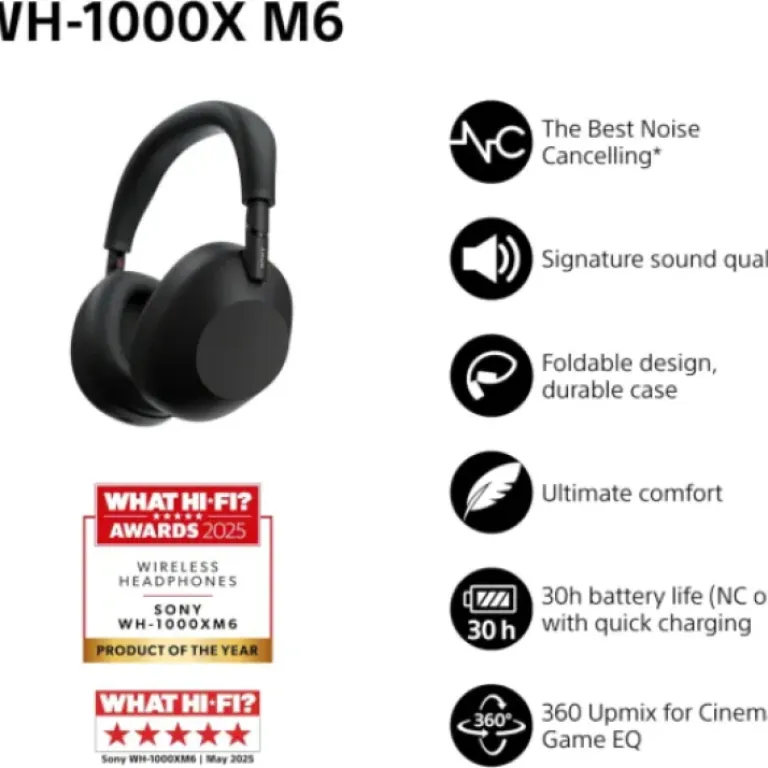

Summary
Editor's rating
Value: strong features, but the upgrade from XM4 is debatable
Design: compact case, discreet look, some small annoyances
Battery: genuinely long‑lasting, charges quickly enough
Comfort: good for a few hours, not ideal for all‑day wear
Durability & build: light plastic that feels okay but not indestructible
Performance & ANC: quiet, clear, and easy to tweak
Pros
- Strong noise cancelling and very natural ambient / transparency mode
- Good sound quality with a useful 10‑band EQ and solid app features
- Long battery life with practical fast charge and multipoint Bluetooth
Cons
- Clamp and thinner headband padding can cause discomfort over long sessions
- High price, especially as an upgrade from the XM4
- Mostly plastic build that doesn’t feel very premium and ear pads can stain from sweat

Specifications
View full product page →| Brand | Sony |
Sony’s latest flagship on my head all week
I’ve been using the Sony WH‑1000XM6 as my main headphones for about two weeks, mostly for work at home, commuting on trains and buses, and a couple of long gaming sessions on PC and PS5. Before these, I used the XM4 for a year and tried the Bose QC45 and Apple AirPods Max for a few days each, so I have a decent idea of how they stack up. I’m not an audiophile, I just sit in front of a laptop all day and want silence and good sound that doesn’t give me a headache.
The short version: the XM6 are very strong on noise cancelling and features, the sound is easy to tune to your taste, and the app is one of the best parts. But they’re not perfect, especially on comfort if you’re sensitive to clamping or headband pressure, and the price is on the high side if you’re coming from an XM4 that still works fine.
In daily use, what stood out most to me was how quiet they make a bus or an open‑plan office feel, and how quickly they switch between my phone and laptop. I didn’t have any real connection drama, and the battery basically never stressed me out, even when I forgot to charge for a few days. That’s the good side.
On the downside, the headband padding is clearly thinner than the XM4, and you feel the clamp more. After about an hour and a half, I usually need to shift them around a bit or take a short break. So if your main priority is all‑day comfort, this is something to think about. I’ll go through each point in more detail below, but that’s the overall picture.
Value: strong features, but the upgrade from XM4 is debatable
On value, it really depends where you’re coming from and what price you pay. At full retail (around the 300+ £/€ mark), the WH‑1000XM6 are not cheap, but you do get a lot: top‑tier ANC, good sound with proper EQ, multipoint Bluetooth, strong battery, a solid app, and a decent case. If this is your first high‑end noise‑cancelling headphone and you find them on sale, I’d say the package as a whole is pretty solid for the money.
If you already own the XM4, it’s more complicated. The jump in ANC is there but not huge, sound can be tuned similarly thanks to the new 10‑band EQ, and the main differences you’ll really notice day to day are: slightly better pass‑through, foldable design with a nicer case, a bit cleaner call quality, and a tighter clamp with less comfy headband. So you’re paying a fair amount for incremental upgrades and maybe a small downgrade on comfort. In that situation, I’d only upgrade if you find a good discount or your XM4 battery is starting to fade.
Compared to Bose QC45/QC Ultra and Apple AirPods Max, the XM6 sit in a good middle ground. Bose usually win on comfort and simple, out‑of‑the‑box ease, but Sony beat them on app features, EQ flexibility, and usually on ANC strength. AirPods Max feel more premium and integrate better with Apple devices, but they’re heavier, bulkier to carry, and more expensive. So for mixed Android/iOS/PC use, the XM6 make a lot of sense, especially thanks to multipoint and the app.
So overall value: good, but not mind‑blowing. If you get them around £270–£300 in a sale, they’re easier to recommend. At full price, they’re still one of the best all‑rounders, but not automatically the obvious choice if comfort is your number one priority or you already own a recent Sony model.
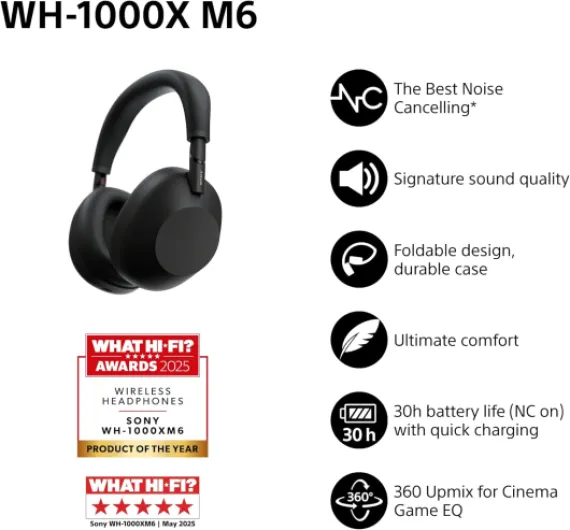
Design: compact case, discreet look, some small annoyances
Design‑wise, the WH‑1000XM6 are pretty low‑key and practical. They’re mostly matte plastic with a simple Sony logo, so you don’t get that flashy "look at me" vibe you get with AirPods Max. I actually like that. On public transport or in a café they don’t draw attention, and because they’re plastic, you’re less stressed about babying them. They feel light in the hand and on the head, which is important when you’re wearing them for a few hours straight.
The big design change compared to the XM5 is that they fold again, and the new case is smaller and has a magnetic closure instead of a zip. In practice, that matters more than I expected. It actually fits in a backpack without taking half the space, and the magnetic lid is quicker to open than a zip when you just want to throw them on. Inside the case you have a small pocket for the cable. Nothing fancy, but it’s functional and feels more robust than the XM4 case I used to have.
The controls are a mix of touch gestures on the right earcup and physical buttons. Double tap for play/pause, swipe for volume and track changes, and a button for ANC/ambient mode. The touch surface works fine most of the time, but in winter with gloves or when your hands are slightly wet, it gets a bit annoying. One thing I like is the Quick Attention feature: put your hand over the right earcup and it drops the volume and turns on ambient sound so you can talk to someone or hear a train announcement. It sounds like a gimmick, but I use it a lot.
On the slightly negative side, the left/right markings are not very obvious, especially in low light. More than once I picked them up quickly and put them on backwards, then wondered why the controls felt off. Also, the mics and sensors inside the cups stick out a bit. I don’t personally feel them on my ears, but I can see how someone with larger ears or a different ear shape might find that annoying over time. Overall, the design is practical and understated, but not perfect.
Battery: genuinely long‑lasting, charges quickly enough
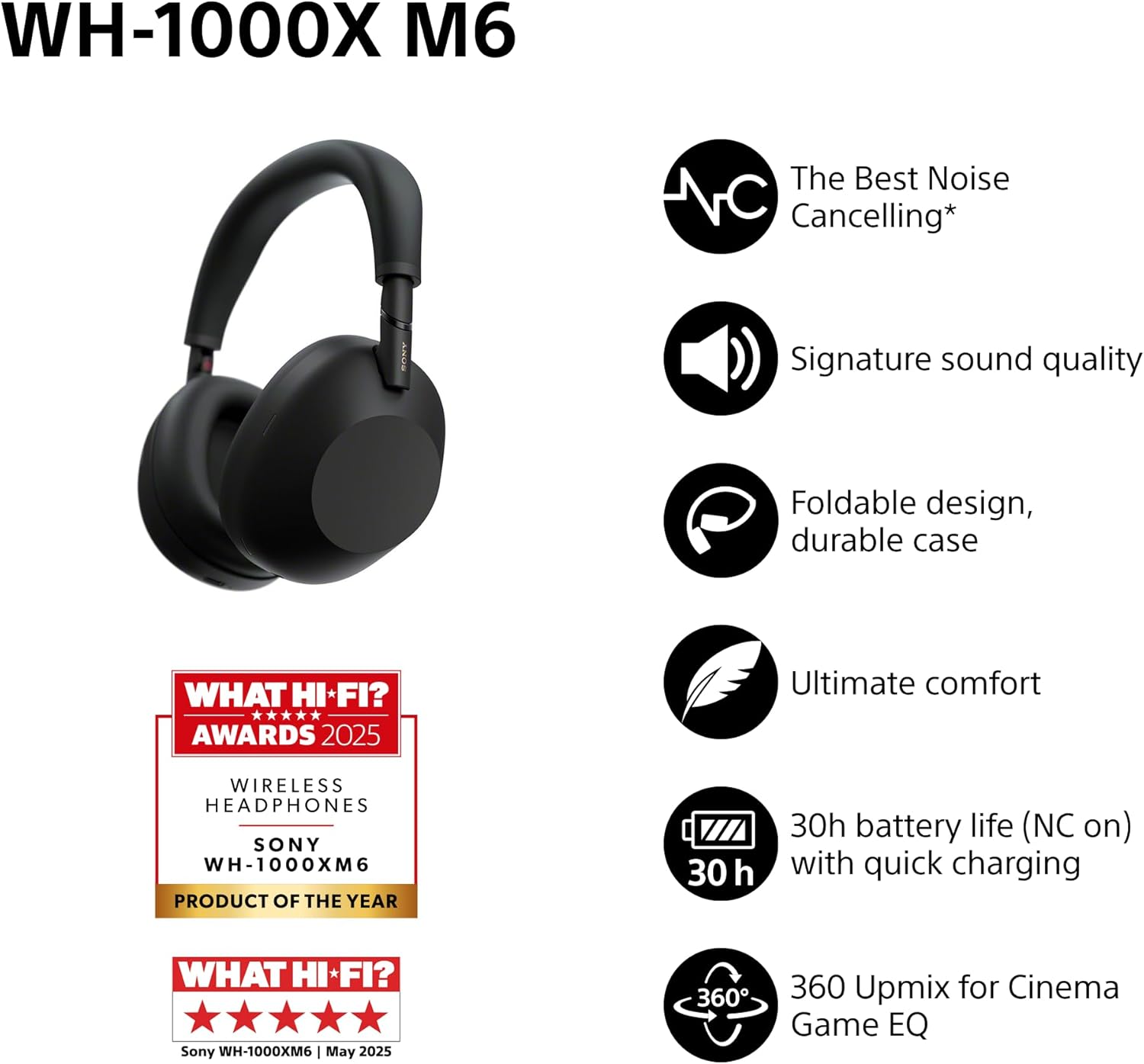
The battery on the WH‑1000XM6 is one of the things I barely had to think about, which is a good sign. Sony claims up to 30 hours with ANC on and up to 40 with it off. In real life, with ANC always on, multipoint connected to phone and laptop, and volume around 50–60%, I was getting roughly 4–5 workdays of mixed use (about 5–6 hours per day) before needing to charge. That’s in the 25–30 hour range, which lines up pretty well with the spec.
The fast charge is actually useful. One morning I forgot they were almost empty, plugged them in for about 10 minutes while making coffee, and that was enough for a full afternoon of music and calls. Sony says 3 minutes for 3 hours of playtime; I didn’t time it precisely, but the general idea holds: short top‑ups give you plenty of time. Also, you can keep listening while charging via USB‑C, which is handy if you’re stuck at your desk and don’t want silence.
The app shows battery percentage, and the headphones give you a voice prompt when you turn them on (“Battery about 50%” etc.). That’s enough for me; I never once hit 0% in the middle of the day. The only thing to note is that using LDAC (hi‑res Bluetooth) and high volume will drain faster than SBC/AAC, but even then it’s still decent. For most people using Spotify or YouTube with standard codecs, you’ll charge these maybe once or twice a week, not daily.
Overall, I’d call the battery life very solid and reliable. It’s not a headline feature you’ll brag about, it just quietly does its job. If you travel a lot, you can easily handle a long‑haul flight plus airport time on a single charge, which is what matters. No real complaints here.
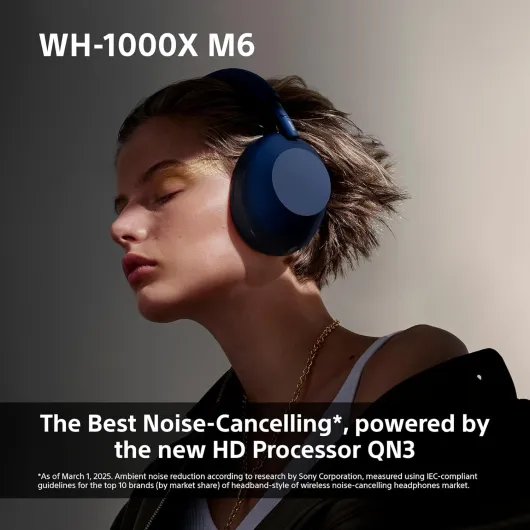
Comfort: good for a few hours, not ideal for all‑day wear
Comfort is where the XM6 is a bit mixed. The headphones are light (around 250 g), which helps a lot, but Sony clearly stiffened the clamp compared to the XM4 and the headband padding is thinner. I noticed this on day one: after about 60–90 minutes, I start to feel a pressure line on the top of my head and a bit of squeeze around the jaw. It’s not painful, but it’s there, and with the XM4 I could forget I was wearing them for longer.
The ear pads themselves are soft and pleasant at first. The contact around the ear is well distributed, and they seal well without digging into the skin. I didn’t feel the ANC sensor touching my ears, which some people online complained about, but I can imagine if your ears stick out more, it might be different. One thing I did notice after a few days is heat: after a long session (2–3 hours), my ears get quite warm. That’s pretty standard for over‑ear, but if you live somewhere hot or tend to sweat, it’s something to keep in mind. Some users mentioned switching to thicker third‑party pads (like Wicked Cushions) and said that helped both comfort and sweat cleaning.
On the headband side, if you don’t have much hair, you’ll probably notice the reduced padding. I shaved my head recently and the difference compared to the XM4 was pretty clear. The band is not harsh, but you do feel a harder line on the scalp after a while. I found that slightly extending the headband and lowering the cups helped spread the pressure a bit, but it’s still not as comfy as the XM4 or some Bose models for long days. For short commutes or a movie, it’s fine; for an 8‑hour workday, I tend to take mini breaks.
Overall, I’d rate comfort as good but not the best in class. If your priority is pure comfort and you wear headphones 6–8 hours straight, Bose or even the older XM4 might suit you better. If you’re more in the 1–3 hours per session range, the XM6 are perfectly usable, just don’t expect them to disappear on your head.
Durability & build: light plastic that feels okay but not indestructible
In terms of durability, the WH‑1000XM6 sit in that light but mostly plastic category. They don’t feel cheap, but they also don’t feel like a tank. The upside is the low weight; the downside is you’re not going to want to twist them or throw them around. The hinges for the folding mechanism feel more solid than the XM4 to me, with a smoother action and no creaking so far. I opened and closed them a lot the first few days and didn’t notice any play or weird noises.
The matte finish on the black model does a decent job hiding fingerprints, but it will show small scratches over time if you’re rough with them. One thing I noticed is the ear pads can stain a bit from sweat or skin oils, especially if you use them in warm conditions. Wiping them with a soft cloth helps, but they don’t go back to perfect "day one" look. That matches what some users said: a few ended up buying third‑party pads that are easier to clean and slightly thicker. Good news is the pads are replaceable without too much hassle, so you’re not stuck when they wear out.
The included case is actually a big part of the durability story. Because the headphones fold and the case is fairly rigid with a magnetic closure, I feel comfortable just tossing it into a backpack with other stuff. It protects the cups and headband well. This is better than some soft pouches you get with cheaper models. If you’re someone who travels a lot or shoves their bag under seats, the case will probably save you from accidental damage more than once.
I can’t speak to multi‑year durability yet, but based on past Sony models (XM3/XM4) and how this one feels in the hand, I’d say it should hold up fine if you’re moderately careful. It’s not a rugged product; drop it hard on concrete and you might regret it. But for normal daily use — bag, desk, commute — it feels solid enough. Just don’t expect metal‑body levels of toughness.

Performance & ANC: quiet, clear, and easy to tweak
On performance, the WH‑1000XM6 are very strong overall. Let’s start with noise cancelling. On buses and trains, engine rumble and general road noise basically vanish. Voices around you are heavily reduced; you still hear some higher‑pitched sounds like a loud cough or a bus door screech faintly, but it’s heavily dampened. Compared to my old XM4, I’d say ANC is a bit better, especially in the low‑mid range, but not a huge jump. Where I really noticed a difference is ambient / transparency mode: it sounds much more natural, less muffled. When I switch to ambient at my desk, it almost feels like I’m not wearing headphones, which is a big plus for quick chats.
Sound quality out of the box is a bit V‑shaped: bass is present, mids are slightly pulled back, highs are clear without being harsh. It’s good already, but the real strength is the Sony app. The 10‑band EQ lets you actually tune the sound properly, not just pick vague presets. I boosted the mids a bit and slightly cut the low bass, and suddenly a lot of tracks I know well sounded more detailed. I also tried the 360 Upmix for movies, and while it’s not real surround, it does give a bit more space and width to soundtracks. For gaming, the dedicated EQ preset does help bring out footsteps and small details, though there’s still some latency over Bluetooth unless you use a cable or a low‑latency adapter.
Calls were surprisingly solid. I did a few work calls with a TV on in the background and a fan running. People on the other side said they could barely hear the background noise. The six beamforming mics plus AI noise reduction seem to do their job. It’s not like a studio mic, but for Teams/Zoom and phone calls, it’s more than good enough. Outside in wind, the wind noise reduction helps, but you still get some gusts coming through; it’s better than many cheaper headphones, but not magic.
In daily use, the extra features are a mixed bag. Speak‑to‑Chat (music pauses when you talk) works, but it’s a bit too sensitive for me; it sometimes triggers if you hum or clear your throat, so I turned it off. Adaptive Sound Control, which changes ANC/ambient depending on where you are, is nice in theory, but I ended up keeping things manual most of the time. Still, the core performance — ANC, sound quality with EQ, and stable Bluetooth — is very solid, and that’s what matters most.
Pros
- Strong noise cancelling and very natural ambient / transparency mode
- Good sound quality with a useful 10‑band EQ and solid app features
- Long battery life with practical fast charge and multipoint Bluetooth
Cons
- Clamp and thinner headband padding can cause discomfort over long sessions
- High price, especially as an upgrade from the XM4
- Mostly plastic build that doesn’t feel very premium and ear pads can stain from sweat
Conclusion
Editor's rating
The Sony WH‑1000XM6 are very solid all‑round wireless headphones with strong noise cancelling, flexible sound thanks to a good EQ, and a feature‑rich app. In day‑to‑day use, they handle commuting, office work, and travel easily: engines and background chatter drop to a low murmur, music sounds clear and punchy once you tweak it to your taste, and the battery lasts long enough that you barely have to think about charging. Multipoint connection between phone and laptop works well, and the compact folding design plus sturdy case make them easy to throw in a bag.
They’re not perfect, though. Comfort is the main weak point: the clamp is a bit tight and the headband padding is thinner than on the XM4, so if you have a sensitive scalp or wear them for many hours straight, you may feel pressure after a while. The build is mostly plastic, which keeps weight low but doesn’t feel especially premium, and the price is on the high side at launch. If you already own XM4 in good condition, the upgrade is more of a small step than a big leap.
I’d recommend the WH‑1000XM6 to people who want strong ANC, good sound with customisation, and lots of smart features, and who usually listen in 1–3 hour chunks rather than all day with no break. They’re great for commuting, shared offices, and travel. If your top priority is cloud‑like comfort for 8‑hour sessions, or if you’re happy with your XM4, you might want to stick with what you have or look at Bose instead. But as a modern, feature‑packed pair of noise‑cancelling headphones, the XM6 get the job done very well overall.