
Summary
Editor's rating
Value for money: who should actually buy this
Design and ergonomics: nice in the hand, a bit bulky on the go
Battery life: good enough, but not an endurance monster
Everyday usability and comfort in real life
Build quality and how tough it feels
Sound and power: plenty of punch, clean and quiet
What you actually get and how it fits into a setup
Pros
- Clean, neutral sound with enough power to drive many full‑size headphones, especially via 4.4 mm balanced
- Versatile: works as Bluetooth receiver and high‑res USB DAC for phone, PC, and even car/home systems
- Solid build quality with sturdy jacks and useful screen, plus charging control switch for USB use
Cons
- A bit bulky and heavy for clipping to a shirt collar; more pocket‑friendly than wearable
- Menu and button combinations are not very intuitive at first and the app is only average
- Battery life is decent but not great, especially when using balanced output and high gain

Specifications
View full product page →| Brand | FiiO |
A pocket DAC that actually feels like a real upgrade
I’ve been using the FiiO BTR7 for a few weeks now, mostly with my phone and laptop, and I’ll be straight: it’s not just a tiny volume booster. It actually changes how my headphones sound in a pretty noticeable way. I came from basic dongle DACs and built‑in laptop outputs, and the jump in control and clarity is real. Not mind‑blowing, but clearly a step up you can hear even without golden ears.
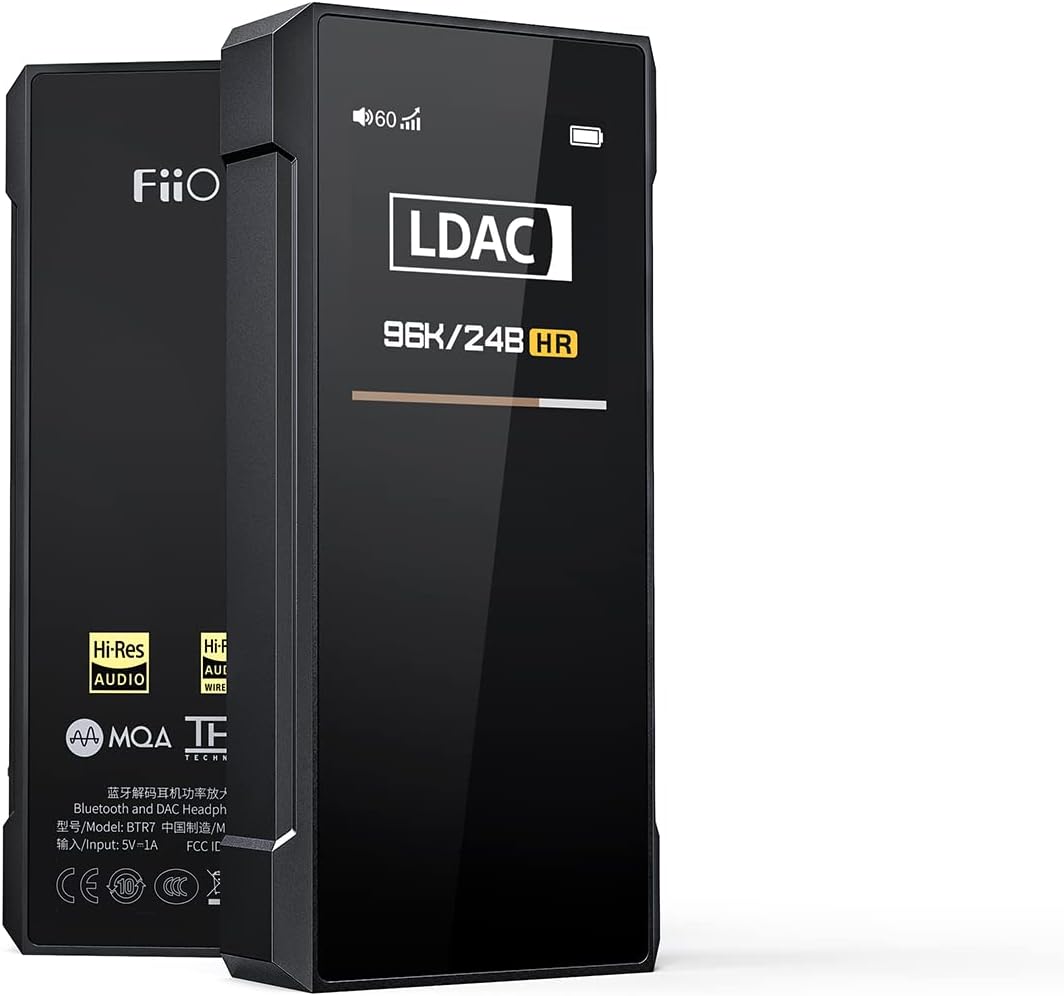
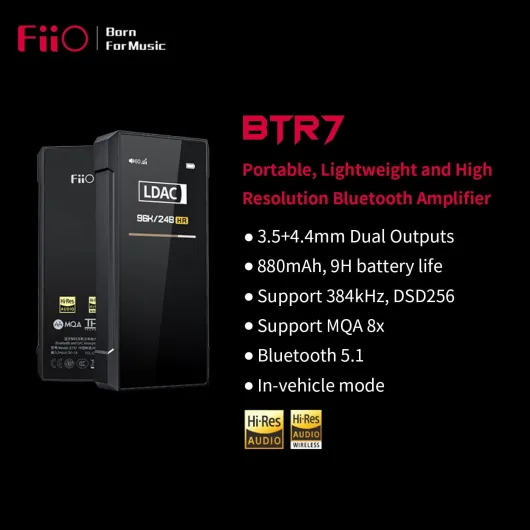
My use case is simple: I wanted something small I can throw in my pocket, use over Bluetooth on the go, and plug in via USB‑C at my desk. I also wanted enough power to drive more demanding headphones like HD600/HD660S type stuff, not just easy IEMs. The BTR7 ticked all the boxes on paper: dual ES9219C DACs, 3.5 mm plus 4.4 mm balanced output, LDAC, aptX HD, and a screen so you’re not guessing settings from random beeps.
In practice, it does what it promises, but it’s not perfect. The sound and power are solid, but the software and menus are a bit clunky, and the size is borderline big for a “clip on and forget” device. Also, the battery is fine but not legendary, especially if you push it in balanced mode with higher gain. It’s more a small desk/portable rig than a super‑minimal shirt‑collar clip in my opinion.
If you’re expecting miracle sound from bad MP3s or cheap headphones, this won’t magically fix everything. But if you already have decent IEMs or headphones and you’re tired of weak phone outputs or flaky dongles, the BTR7 is a pretty serious little box. I’ll walk through what worked for me and what annoyed me, so you can decide if it fits how you actually listen.
Value for money: who should actually buy this
In terms of value, the BTR7 sits in that mid‑range zone: not cheap, not crazy high‑end. For the price, you get a lot of features: dual DACs, proper balanced output, Bluetooth 5.1 with all the good codecs (LDAC, aptX HD, aptX Adaptive, etc.), USB DAC with high‑res and DSD support, MQA rendering, a screen, and a decent mic. If you compare it to some single‑purpose dongles that cost almost as much but break more easily and lack Bluetooth, it starts to look pretty reasonable.
Where the value really shows is if you actually use it in multiple roles: portable Bluetooth amp, wired USB DAC at your desk, and maybe as a link for your car or home system. If you just want one of those use cases, there might be cheaper and simpler options. For example, if you only need a tiny USB‑C dongle for a phone or laptop, you can spend less and get good sound with fewer features. If you just want a basic Bluetooth receiver for the car, this is overkill.
Compared to its little brother, the BTR5, the BTR7 brings more power, balanced 4.4 mm, a nicer screen, and generally better Bluetooth range. But it’s also bigger and more expensive. If you mainly use sensitive IEMs and don’t care about balanced or driving 300‑ohm headphones, the BTR5 or even cheaper options might be enough. So the BTR7 is better value if you know you’ll take advantage of the extra power and outputs.
For someone with mid to higher‑end IEMs or headphones who wants one device that can move between phone, PC, and maybe car, the BTR7 is good value for money. It’s not the cheapest way to get into better sound, but it’s a solid all‑rounder. If your budget is tight or your headphones are very easy to drive, you can definitely spend less and still be happy. But if you’re tired of flaky dongles and weak outputs and want something more serious without going full desktop, this sits in a nice middle ground.
Design and ergonomics: nice in the hand, a bit bulky on the go
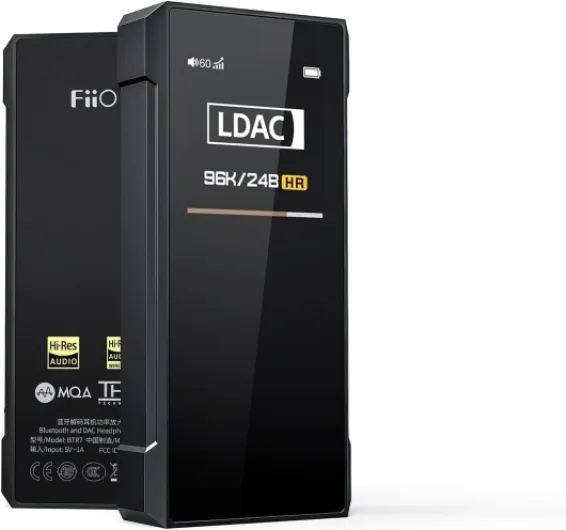
The BTR7 looks and feels like a small, chunky smartphone remote. Aluminum alloy frame, glass front, and a color screen in the middle. It’s not huge, but it’s definitely bigger than the older BTR5 or tiny dongles. In the pocket, no problem. Clipped to a shirt collar or light T‑shirt, you feel the weight a bit, and it tugs if you move around a lot. I ended up clipping it to a jacket pocket or just letting it sit in a pants pocket with the cable going up.
Button layout is mostly logical once you learn it. On one side you get power/menu, play/pause/call, and volume/track buttons. On the other side, there’s a little switch to control charging behavior when used as a USB DAC (handy if you don’t want it draining your laptop or cooking its own battery all day). On top: 3.5 mm single‑ended jack and 4.4 mm balanced. Bottom: USB‑C port. The physical controls have dual functions with long presses, which is where it gets confusing at first.
What I liked is that everything feels tight and solid. No rattling buttons, the jacks hold plugs firmly, and the USB‑C port doesn’t feel loose. Compared to flimsy dongles I’ve used before, this feels like something that can live in a bag or pocket without babying it. That matches what other users say about it feeling more solid than some competing dongle DACs that tend to break at the jack.
On the downside, it’s not the most discreet device. If you wanted something feather‑light to clip right next to your mouth for calls, this is on the big side. Also, the glossy glass front picks up fingerprints easily, and I can see it scratching if you throw it in a bag with keys. So in terms of design: premium feel and smart layout, but a bit too big to fully disappear in daily use, especially for people who like to clip these to shirt collars.
Battery life: good enough, but not an endurance monster
Battery life on the BTR7 is okay to good, depending on how you use it, but it’s not the kind of device you charge once a week and forget. With Bluetooth, low gain, single‑ended output, and moderate volume, I was getting around a full workday of mixed use (music plus a few calls) before I felt like I should plug it in. If you push it harder with 4.4 mm balanced, higher gain, and louder listening, it drops closer to 6–7 hours in my experience. That lines up with what other users report.
For my use, that’s fine: I usually charge it overnight or during lunch via USB‑C. It supports fast enough charging that a short top‑up gives you a few more hours. What I really liked is the charging switch on the side for USB DAC mode. You can decide if you want it to charge from your laptop/PC while connected, or just run off its own battery. That’s handy if you don’t want to constantly cycle the internal battery whenever you plug it into a computer for longer listening sessions.
One thing to keep in mind: all the fancy stuff costs battery. Balanced output, high gain, Bluetooth with LDAC, screen on more often, all chew through power faster. If you mostly use it wired via USB‑C as a DAC/amp, the drain feels slower and more predictable. For travel, I’d say it’s okay for flights and commutes, but if you’re doing a 12‑hour travel day and hammering it on balanced, bring a power bank or expect to recharge somewhere.
So overall: battery life is decent but not standout. If you’re coming from tiny dongles that draw power from your phone, this is a different trade‑off: you save your phone battery but now you manage a second device. Personally, I’m fine with that, but if you hate charging gadgets, it’s something to consider.
Everyday usability and comfort in real life
Comfort with a device like this is more about how it fits into your routine than how it feels on your head. For me, the BTR7 works best either in a pants pocket or clipped to a jacket pocket. Clipping it high on a T‑shirt collar is possible, but between the weight and the cable tug from your headphones, it’s not the most comfortable setup if you’re moving a lot. Walking around town? Fine. Running or gym? I wouldn’t bother; I’d just use Bluetooth earbuds.
The buttons are small but clicky enough, and after a few days I could adjust volume and pause/play without looking. The screen helps for quick checks: codec, battery, gain level. One slightly annoying thing is remembering all the long‑press vs short‑press combos, especially when you want to enter the menu or change a setting on the fly. It’s the typical “too many functions, not enough buttons” problem. Once you set it how you like, daily use is easy enough, but the first week is a bit of a learning curve.
Microphone and calls are usable but not great. People could hear me, but it’s not at the level of a good phone mic close to your mouth or decent true wireless earbuds. In a quiet room or car, it’s fine; outside in wind or in a noisy street, it struggles. Still, for me it’s a plus that it even has a mic, since many similar devices skip it. It means I don’t have to unplug everything when a call comes in; I just hit the button and talk.
In terms of mental comfort, the BTR7 is one of those devices you kind of “set and forget” once you get used to it. Turn it on, it auto‑connects to your last device, plug in your headphones, done. It’s not as seamless as AirPods or similar, but for a more audiophile‑leaning gadget, it’s pretty straightforward once dialed in. Just don’t expect it to disappear like a tiny dongle; you feel that you’re carrying and managing an extra piece of gear.
Build quality and how tough it feels
Build quality is one of the strong points of the BTR7. The aluminum alloy frame feels solid, and the high‑strength glass front hasn’t shown any scratches yet in my use, though I’ve mostly kept it in the included case. The buttons don’t wobble, and the jacks feel firmly mounted. Compared to some dongle DACs I’ve owned where the headphone jack eventually broke loose inside (looking at some well‑known brands), this feels more confidence‑inspiring.
I’ve thrown it in a bag a few times, accidentally dropped it from desk height once, and so far it’s totally fine. No weird rattles, no cracks, nothing. The included leatherette case is simple but adds a bit of grip and protection around the edges, which helps. I’d recommend using it, mainly to protect the glass from keys and coins. It’s not a rugged device, but it’s not fragile either. More like a small, sturdy remote than a delicate audio jewel.
Connectors are often the weak point on these things, and here they feel solid. The USB‑C port hasn’t loosened up with repeated use, and both 3.5 mm and 4.4 mm hold plugs firmly without crackling or cutting out when moved. That’s important if you plan to keep it in a pocket while walking, because cheap jacks often start crackling after a while with that kind of stress.
Long‑term battery durability is harder to judge yet, but there is at least that charging control switch that lets you avoid constantly topping it up from a PC, which should help the battery age a bit better. Overall, I’d classify durability as pretty solid for daily carry, as long as you’re not throwing it on concrete or soaking it. It’s not marketed as waterproof or shockproof, so basic care is still needed.
Sound and power: plenty of punch, clean and quiet
Let’s talk sound, because that’s the real point of this thing. In short, the BTR7 delivers clean, controlled, fairly neutral sound with enough power for most headphones people actually use on the go. I tried it with a mix of gear: Moondrop Aria IEMs, some budget KZ IEMs, Sennheiser HD600 and HD660S‑type headphones, and a couple of easier portable headphones from Sony and Sennheiser. On low‑impedance IEMs, noise floor is basically silent, even on higher gain. No hiss that I could hear, which is important if you’re sensitive to that.
On power, it does better than I expected for a portable Bluetooth unit. On the 4.4 mm balanced output, it drives 300‑ohm Sennheisers to more than enough volume with good control. Bass doesn’t feel loose, and you don’t get that “thin and struggling” feeling that you often get from phone jacks. It’s not on the level of a big desktop amp, but for a pocket device it’s very respectable. Single‑ended 3.5 mm is weaker, but still fine for most IEMs and easy portable headphones.
Compared to basic dongles and laptop outputs, the biggest difference I noticed is in separation and bass control. Tracks feel less congested, especially when there’s a lot going on (rock, metal, electronic). The DAC section (dual ES9219C plus XMOS USB chip) seems to do its job without adding a strong color. It’s not super warm or super bright to my ears. If anything, it leans slightly clean/neutral, which works well with warmer headphones and IEMs. With already bright gear, it can sound a bit sharp on bad recordings, but that’s more the chain than the BTR7 alone.
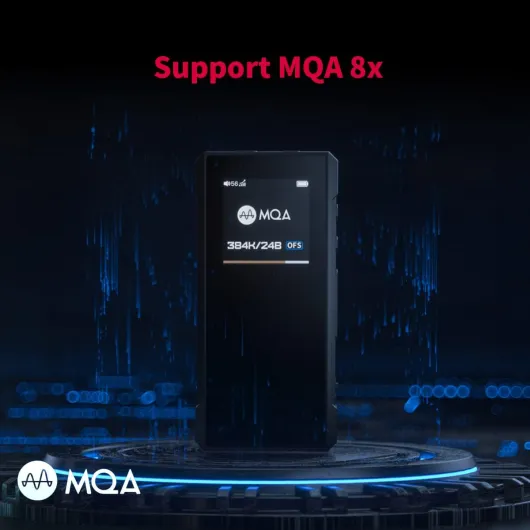
Bluetooth performance is decent. LDAC and aptX HD both worked reliably for me at home and in the office. Range is better than older FiiO units; I could walk to another room without dropouts. Still, it’s Bluetooth: sometimes you get a little glitch or codec switch, but nothing dramatic. For critical listening, I just plug it in via USB and use it as a wired DAC/amp. In that mode, it supports up to PCM 384 kHz, DSD256, and MQA rendering. I’m not an MQA fanatic, but I tested some Tidal tracks and it handled them as advertised.
What you actually get and how it fits into a setup
Out of the box, the BTR7 feels like a complete little package. You get the unit, a simple leatherette case, a short USB‑C to USB‑C cable, and a USB‑C to USB‑A cable. No 4.4 mm or 3.5 mm headphone cables included obviously, so you’ll use your own. The case is basic but useful: it protects the glass and the metal body, and it doesn’t make the device much bulkier. Overall, it feels like FiiO thought about real use, not just shelf appeal.
In terms of how it integrates into a setup, I’ve used it three ways: Bluetooth from my phone, USB‑C from my laptop as a pure DAC/amp, and plugged into my car via aux while my phone streams to it. It handled all three without drama once configured. On Windows, you do need to grab the FiiO driver if you want full high‑res support and stable playback. On my Android phone, it was just pair and go, with LDAC kicking in automatically once I set it in the FiiO control app.
The screen actually helps more than I expected. You can see codec (LDAC, aptX HD, etc.), gain level, battery, and output mode. It’s small but readable. The downside is the menu system: it’s not intuitive at first and the combination of long‑press/short‑press on buttons is easy to mess up. Once you set it the way you like (gain, filter, USB mode, etc.), you rarely need to dive back in, but the first 2–3 days I had to grab the manual a couple of times.
In daily use, it feels like a little hub for all your audio: phone, laptop, tablet, even car. That’s the main point of this thing. If you just want a tiny dongle that never needs touching, this is overkill. But if you like the idea of one box that can move between your desk, your pocket, and your car while keeping a consistent sound, the BTR7 fits that role pretty well.
Pros
- Clean, neutral sound with enough power to drive many full‑size headphones, especially via 4.4 mm balanced
- Versatile: works as Bluetooth receiver and high‑res USB DAC for phone, PC, and even car/home systems
- Solid build quality with sturdy jacks and useful screen, plus charging control switch for USB use
Cons
- A bit bulky and heavy for clipping to a shirt collar; more pocket‑friendly than wearable
- Menu and button combinations are not very intuitive at first and the app is only average
- Battery life is decent but not great, especially when using balanced output and high gain
Conclusion
Editor's rating
After using the FiiO BTR7 across phone, laptop, and car, my take is pretty simple: it’s a strong all‑round portable DAC/amp with a couple of quirks. Sound quality is clean and controlled, with enough power from the 4.4 mm balanced output to drive more demanding headphones like 300‑ohm Sennheisers to satisfying levels. For IEMs and typical portable headphones, it’s easily enough and stays quiet with no annoying hiss. Bluetooth performance is stable, and USB DAC mode turns it into a legit small desktop setup.
On the negative side, it’s not tiny, so if you wanted something feather‑light for shirt‑collar use, this might feel bulky. The menu system is a bit clumsy at first, and the mic is usable but nothing special. Battery life is fine but not crazy; expect a workday with reasonable use, less if you hammer it in balanced mode. None of these are deal‑breakers, but they’re worth knowing before you buy.
I’d recommend the BTR7 to people who already have decent wired headphones/IEMs and want one device that can handle both portable and desk use without feeling cheap. If you’re into balanced cables, higher‑impedance headphones, or you want to ditch flaky dongle DACs, it’s a solid choice. If you mostly use easy IEMs, don’t care about balanced, or you just want something ultra‑small and simple, the BTR5 or a cheaper dongle might be a better fit. Overall, it’s a good, practical upgrade, just not magic.