
Summary
Editor's rating
Value for money: worth it if you actually use its features
Design: more desktop mini-brick than featherweight clip
Battery life: okay for a day, not a marathon champion
Build and durability: feels solid, but the glass front needs care
Sound and Bluetooth performance: very solid, especially with balanced output
What the BTR7 actually is and how I used it
Pros
- Strong sound performance for the size, especially using the 4.4mm balanced output
- Very flexible: works as Bluetooth receiver and USB DAC for phone, PC, and car
- Solid build quality with useful extras like the charge on/off switch and included cables/case
Cons
- Bulkier and heavier than many competing Bluetooth receivers, not ideal for clipping to clothing
- Average battery life only, needs regular charging with heavy use
- Menu and app feel a bit clunky and not very intuitive for beginners

Specifications
View full product page →| Brand | FiiO |
A small box that makes your headphones actually worth their price
I’ve been using the FiiO BTR7 for a few weeks as my main way to listen to music from my phone and laptop, both at home and in the car. Before this, I was mostly using cheap USB-C dongles and sometimes plugging straight into my laptop. So I’m not coming from ultra high-end gear, but I do own a few decent headphones (Sennheiser HD6XX, some IEMs, and a couple of portable closed-back pairs). The idea was simple: one device that can follow me everywhere and give me better sound without turning my setup into a mess of cables.
In practice, the BTR7 really does change how you use wired headphones with modern phones. Instead of juggling dongles and random adapters, I just clip this to my pocket or leave it in the car and connect over Bluetooth. The strong point for me is that it works as both a Bluetooth receiver and a USB DAC, so I can use it with my phone on the go and then plug it into my PC when I’m at my desk. I didn’t have to change my whole setup, it just slipped in between source and headphones.
It’s not perfect, though. The interface is a bit fiddly, the size is bigger than I’d like for something you might clip to your shirt, and the battery is fine but not mind-blowing. Also, if you’re not at least a bit into audio gear, the number of options (gain, filters, Bluetooth codecs, USB mode, etc.) can feel like overkill. I had to spend a bit of time in the menus and the FiiO app before it behaved the way I wanted.
Overall, I’d say this: the BTR7 clearly improves sound compared to basic dongles and direct phone output, especially if you have decent headphones and use the balanced 4.4mm output. But you have to accept a slightly bulky device, average software, and a bit of learning at the start. If that trade-off sounds fine to you, it’s a pretty solid little box.
Value for money: worth it if you actually use its features
Price-wise, the BTR7 sits in that mid-range zone where you start wondering if it’s really worth paying this much for a portable DAC/amp. For the money, you get a lot of stuff: dual DACs, strong enough amp for many full-size headphones, balanced output, high-res Bluetooth codecs, USB DAC mode with XMOS, a small screen, and a half-decent mic. There are cheaper Bluetooth receivers out there, but most of them lack either the power, the balanced output, or the same level of codec support.
If you’re coming from a basic dongle and you own decent wired headphones or IEMs, the price is easier to justify. You’re paying for both convenience and sound quality. For me, the fact that I could use it with phone, laptop, and car without changing devices was a big plus. I basically replaced three different small gadgets with this one. On the other hand, if you’re just using $20 earbuds and streaming in SBC or AAC, you’re kind of wasting what the BTR7 can do, and a cheaper unit (or even just a dongle) might be enough.
There are competitors like the Shanling UP5, Qudelix 5K, and FiiO’s own BTR5. Those are often smaller and cheaper. The BTR7’s main advantages over them are the stronger amp section, balanced 4.4mm (instead of just 2.5mm), the screen, and more of a “mini desktop” feel. But you pay with extra size and only average battery life. So the value really depends on your priorities: if you want power, balanced, and flexibility, the price makes sense. If you want tiny and simple, this is probably overkill.
Personally, I’d rate the value as good, not mind-blowing. It’s not a bargain, but you do get what you pay for in terms of sound and features. Just be honest with yourself: if you’re never going to use balanced output, don’t care about high-res files or LDAC, and just want something small for casual listening, you can save money and go for something simpler.
Design: more desktop mini-brick than featherweight clip
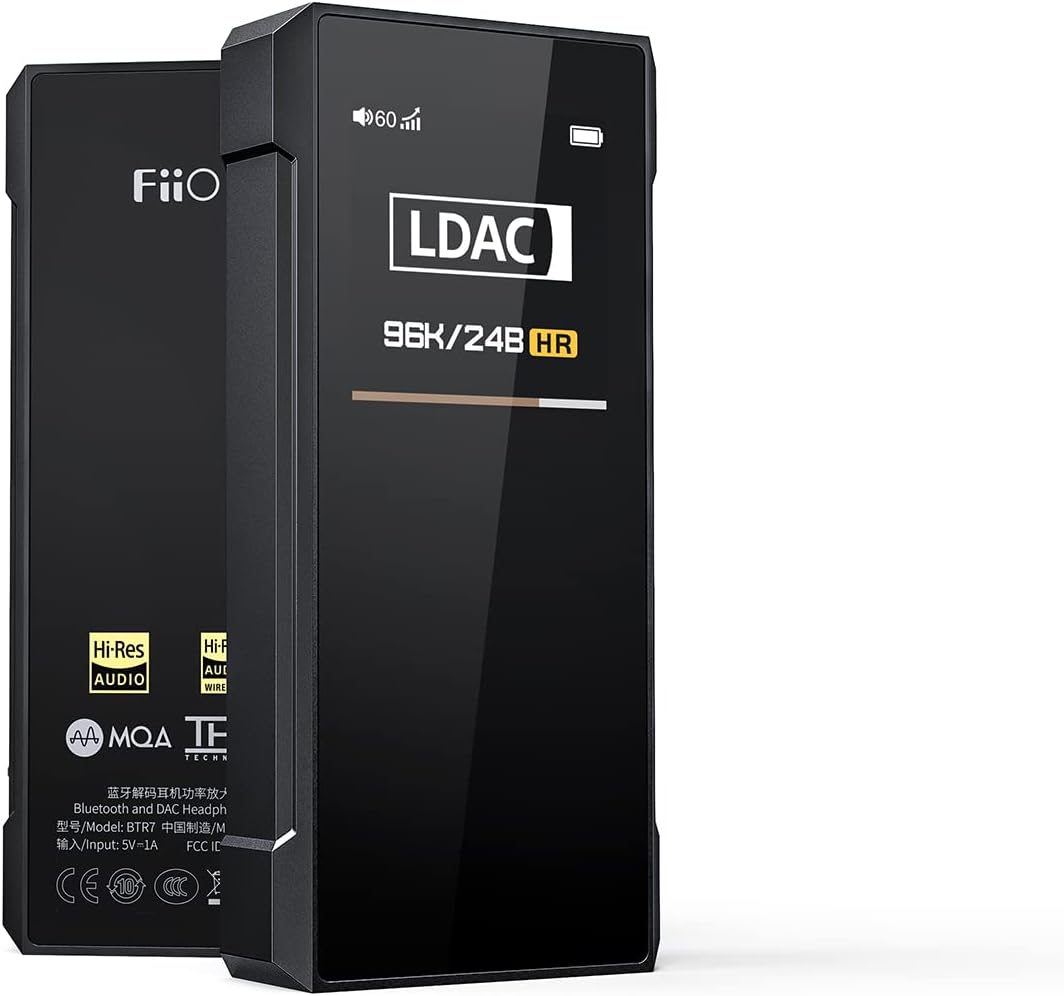
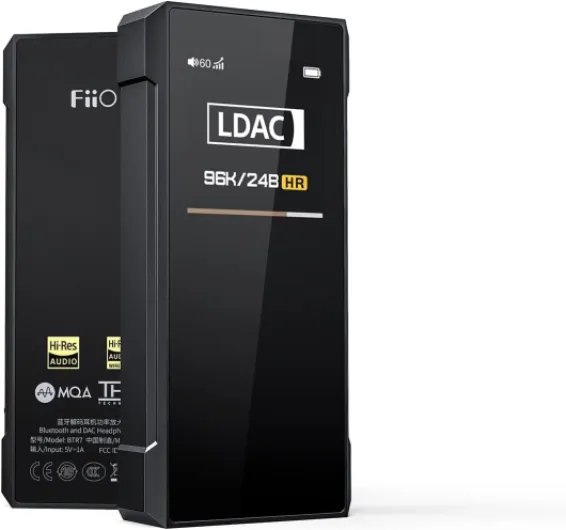
Design-wise, the BTR7 looks pretty serious for such a small device. It’s a little black slab with a glass front, metal frame, and that small color screen in the middle. It feels more like a shrunken-down DAP than a basic Bluetooth dongle. Compared to older FiiO BTR5 or similar units I’ve tried, it’s clearly chunkier: not huge, but definitely thicker and heavier in the hand and in the pocket. If you were hoping for something you forget is there, this isn’t really it.
The layout is mostly logical. On the top you get the 4.4mm balanced and 3.5mm single-ended outputs plus the microphone. On the bottom there’s a single USB-C port for charging and USB DAC use. On the side, the buttons are grouped together: power/menu, a multi-function play/pause/call/pairing button, and a rocker for volume and menu navigation. There’s also a tiny hardware switch to disable charging when connected to a computer or charger, which is a small but very practical idea if you care about battery health.
In daily use, the buttons are okay but not perfect. They’re small and close together, so at first I kept pressing the wrong one in my pocket, especially when trying to change volume without looking. After a few days you get used to the placement, but it’s not as intuitive as a simple volume wheel or clearly separated buttons. The screen is bright enough indoors and readable outdoors if you tilt it a bit, but it’s not something you’ll stare at all the time anyway. It’s more for checking the codec, battery, and confirming settings in the menu.
The main thing to know about the design is that it leans more toward “tiny desktop component” than “super lightweight clip-on receiver.” It’s still portable and easily pocketable, but if you were dreaming of clipping this to a shirt collar and forgetting about it, you’ll probably find it a bit too heavy and bulky for that. I ended up mostly keeping it in a pocket or on the desk, not hanging from clothing.
Battery life: okay for a day, not a marathon champion
Battery life on the BTR7 is decent but not crazy. In my use, over Bluetooth with LDAC or aptX HD, medium gain, and volume around 25–35, I was getting roughly 7–8 hours before needing a charge. If I switched to USB DAC mode and disabled charging via the side switch, it lasted a bit less, which is normal since it’s doing more work. It’s enough for a workday or a long commute, but if you’re expecting 15+ hours, this isn’t it.
The good point is that it charges fairly quickly over USB-C. From low battery to full took roughly 1.5–2 hours in my tests. You can also use it while charging, but then it does get a bit warm, especially in USB DAC mode. Not burning hot, but warm enough that I wouldn’t keep it fully covered in a thick case while charging and playing for hours. The included charge on/off switch is genuinely useful here: if you use it as a desktop DAC a lot, you can avoid constantly topping off the battery and hopefully keep it healthier in the long run.
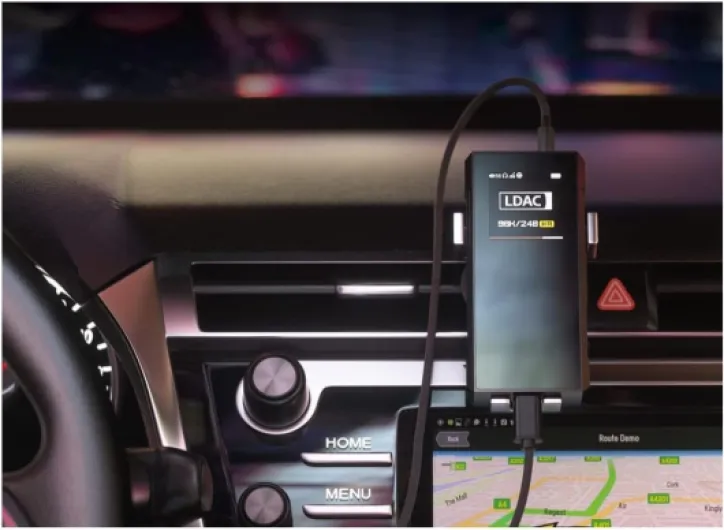
In the car, where I often had it plugged into a USB port for power while feeding the AUX, battery life wasn’t really a concern. Same at the desk when plugged into the PC. Where you’ll feel the limitation is during long days out with no access to a charger. For flights or long road trips where you can’t plug it in, you might want to bring a small power bank, just in case. It’s not that it dies super quickly, it’s just average for the power and features it packs.
If you compare it to smaller, less powerful Bluetooth receivers, some of those do last longer simply because they don’t push as much power and don’t have a screen. So you trade a bit of battery life for more features and output. For my actual use, 7–8 hours was acceptable, but if all-day battery is your top priority above sound power and features, there are better options. For a mix of desk, commuting, and car use, it’s fine as long as you’re okay with charging it regularly.
Build and durability: feels solid, but the glass front needs care
In terms of build, the BTR7 feels sturdy. The metal frame is rigid, the buttons don’t wobble, and the ports don’t feel loose. It doesn’t give the impression that it’ll fall apart after a few months, which is more than I can say about some flimsy dongles I’ve had where the jack literally detached from the PCB. I tossed the BTR7 in a bag a few times (with the case on) and it came out fine, no rattles or weird behavior.
The main weak point for me is the glass front. It looks nice, but it’s also another surface that can scratch or crack if you drop it on a hard floor. I didn’t drop mine from height, only small slips from a desk to a wooden surface, and it survived without marks. Still, I wouldn’t use it bare in the same pocket as keys or coins. The included leatherette case is there for a reason, and I’d say just leave it on. It adds grip and a bit of protection on the corners, even if it doesn’t fully armor the device.
Connectors held up fine during my tests. I swapped cables and headphones a lot, especially on the 4.4mm balanced port, and didn’t feel any looseness developing. The USB-C port also seems solid, but like with any small device, if you keep yanking the cable sideways, you’ll eventually stress it. The physical charge switch is tiny, though; I can imagine that being a weak point if you play with it constantly, so I tried to leave it alone once set.
Long term, I can’t say how the battery will age, but given it’s a sealed device, once the battery goes, you’re probably done unless you’re handy with repairs. That’s common with this kind of gear. Overall, it feels more robust than some popular dongle DACs I’ve seen break, but you still need to treat it like a small electronic device, not like a rugged outdoor gadget. With the case on and a bit of care, I don’t see a big reason to worry about durability in normal usage.
Sound and Bluetooth performance: very solid, especially with balanced output
On the sound side, the BTR7 is where things get interesting. Using the 4.4mm balanced output with my Sennheiser HD6XX and some IEMs, the step up from basic phone output or cheap dongles is clear. You get more headroom, tighter bass, and better control overall. With the 6XX (300 ohms), I had to use high gain and push the volume a bit, but it still drove them to more than enough loudness without sounding strained. For easier headphones and IEMs, low or medium gain was enough, and the noise floor stayed low – I didn’t pick up any hiss with my more sensitive IEMs.
Compared to a simple USB dongle DAC I was using before, the BTR7 gives more punch and a cleaner background. It’s not night and day, but with decent headphones it’s noticeable, especially in busy tracks where cheap outputs tend to blur everything together. I wouldn’t say it beats good desktop amps I’ve tried, but for something this size and portable, it’s pretty solid. If you only listen casually with cheap earbuds though, you probably won’t use half of what this thing can do.
Bluetooth performance is also decent. With my Android phone using LDAC and aptX HD, connection stayed stable in my small apartment, even when I went to another room. It’s better than older receivers I’ve used where the sound would cut out if I put the phone in my back pocket. There’s still the usual Bluetooth limitation: if you put a couple of walls between the BTR7 and the phone, you’ll get drops, but that’s normal. Latency-wise, for music and YouTube it’s fine; for fast gaming, it’s not ideal, but that’s more a Bluetooth thing than the BTR7 itself.
As a USB DAC, latency wasn’t an issue, and it behaved like a normal external audio card once the driver was installed on Windows. I used it for movies and some light gaming without any weird sync problems. The microphone is usable for calls, but it’s not great. People could hear me, but it sounds like a small Bluetooth mic, not like a dedicated headset. It’s handy for quick calls, but I wouldn’t use it for important meetings if you can avoid it. Overall, in terms of sound and connectivity, it does the job very well for the price, as long as you actually need the power and codecs it offers.
What the BTR7 actually is and how I used it
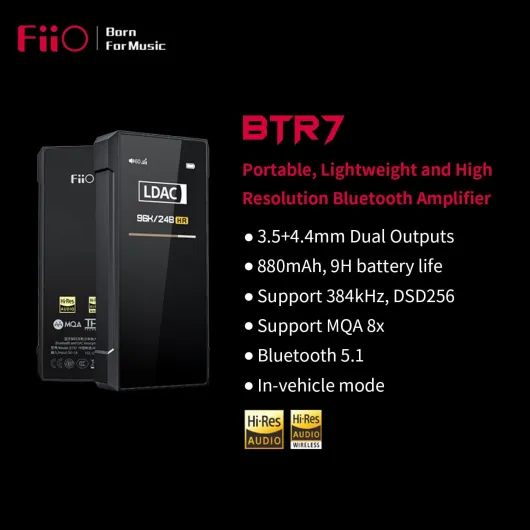
The FiiO BTR7 is basically a portable DAC/amp with Bluetooth. On paper, it checks a lot of boxes: dual ES9219C DACs, XMOS USB chip, support for PCM 384kHz and DSD256, MQA rendering, and Bluetooth 5.1 with LDAC, aptX HD, aptX Adaptive, aptX LL, AAC, and SBC. It has two headphone outputs: a standard 3.5mm and a 4.4mm balanced jack. In short, it’s meant for people who want better sound than their phone or laptop can provide, without carrying a full-size desktop amp.
In my case, I used it in three main ways: clipped to my pocket over Bluetooth with my phone, as a USB DAC at my laptop, and plugged into the AUX of my car to bypass the car’s weak Bluetooth. The included USB-C to USB-A and USB-C to Lightning cables are handy: I didn’t have to buy extra cables to test it with my iPhone and PC. It also comes with a small leatherette case which is actually useful to avoid scratches and gives it a bit of grip on the desk.
The device has a small color screen that helps a lot compared to older tiny Bluetooth receivers with just LEDs. You can see the codec in use, battery level, gain, and volume. Controls are on the side: power/menu button, play/pause and call button, volume rocker that also doubles as navigation, plus a physical charge on/off switch. That last one is helpful when using it as a USB DAC so it doesn’t constantly charge and cook the battery.
So from a pure features standpoint, it’s packed. The downside is that it’s not exactly plug-and-play for everyone. For instance, to use it as a USB DAC on Windows, you need to install the FiiO driver from their site. Bluetooth pairing is easy with phones but a bit more finicky with some laptops. Once it’s set up, it’s fine, but the first 30 minutes are more like setting up a gadget than just plugging in headphones and hitting play.
Pros
- Strong sound performance for the size, especially using the 4.4mm balanced output
- Very flexible: works as Bluetooth receiver and USB DAC for phone, PC, and car
- Solid build quality with useful extras like the charge on/off switch and included cables/case
Cons
- Bulkier and heavier than many competing Bluetooth receivers, not ideal for clipping to clothing
- Average battery life only, needs regular charging with heavy use
- Menu and app feel a bit clunky and not very intuitive for beginners
Conclusion
Editor's rating
After using the FiiO BTR7 daily across phone, laptop, and car, my conclusion is pretty straightforward: it’s a strong all-rounder for people who actually care about sound and own decent wired headphones. The sound quality is clearly better than a basic dongle or straight phone jack, especially if you use the 4.4mm balanced output and have headphones that can benefit from the extra power. Bluetooth performance is stable, codec support is wide, and the ability to switch between wireless and USB DAC mode makes it a flexible little box.
It’s not without flaws. The device is a bit bulky for clipping to clothes, the menu and FiiO app are usable but not very friendly, the mic is only okay, and the battery life is just average for something this size and feature-packed. You also need a bit of patience at the start to set everything up properly, especially on Windows. If you just want something dead simple and tiny to make wired earphones work with your phone, this is probably more than you need.
I’d recommend the BTR7 to people who: use multiple sources (phone, laptop, maybe car), have at least one good pair of headphones or IEMs, and want a single portable DAC/amp that can handle most situations. If you’re a casual listener with cheap earbuds, or if you mainly want long battery life in the smallest body possible, I’d look at cheaper, smaller Bluetooth receivers or even just a solid wired dongle. For the right user though, the BTR7 is a pretty solid balance between power, features, and portability, with enough muscle to make your headphones actually show what they can do.