
Summary
Editor's rating
Is the BTR7 worth the money compared to cheaper options?
Chunky, pocketable, but not really a “clip to your collar” device
Battery life: decent but not a marathon runner
Build quality and long-term feel
Sound quality and power: drives real headphones, not just IEMs
What you actually get and how it fits into a setup
Pros
- Plenty of power, especially from the 4.4 mm balanced output, can drive 300-ohm headphones decently
- Clean, quiet sound over both Bluetooth (LDAC/aptX HD) and USB DAC mode
- Good feature set: dual outputs, screen, wide codec support, USB DAC up to 384 kHz/DSD256
Cons
- Bulkier and heavier than many Bluetooth dongles, not ideal as a light shirt-clip device
- Battery life is only moderate (around 6–8 hours in real use, less with heavy LDAC/balanced use)
- Menu/software experience is a bit clunky and needs some learning and firmware updates

Specifications
View full product page →| Brand | FiiO |
A pocket DAC that’s closer to a mini desktop than a dongle
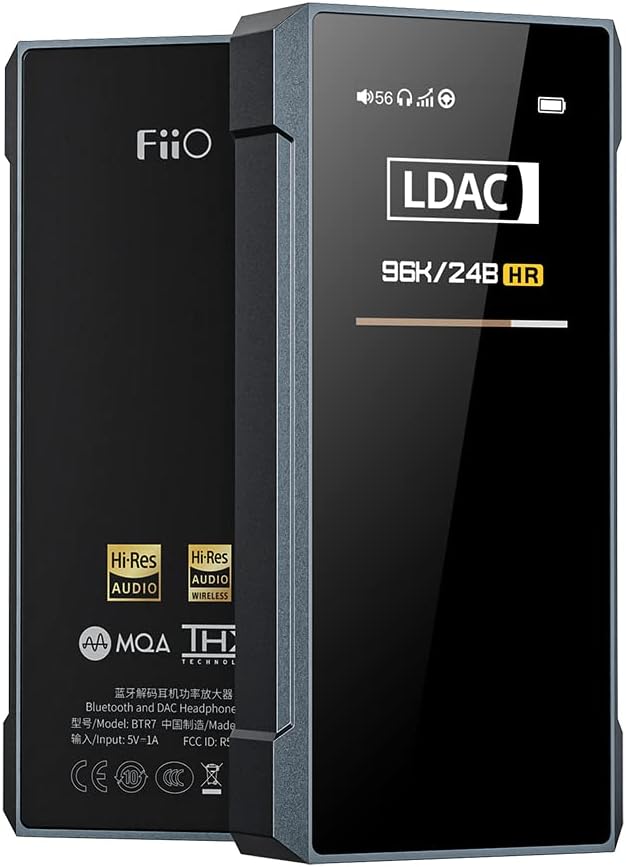
I’ve been using the FiiO BTR7 for a few weeks as my main way to drive wired headphones from my phone and laptop, both at home and on the go. Before this I was mostly on simple dongle DACs and an older BTR5-style device, so I wasn’t expecting a huge jump. In practice, the BTR7 sits in a weird but useful middle ground: more power and features than a tiny dongle, but still something you can throw in a pocket.
My typical use: Spotify/Tidal from Android over LDAC, some USB DAC use on a Windows laptop, and calls during the day. Headphones used: Sennheiser HD600 and HD660S2, a couple of IEMs (Moondrop Aria, KZ), plus some random earbuds. So I’m not measuring anything in a lab, I’m just using it like a normal person who cares a bit too much about sound.
Overall, the first impression is that it’s a powerful, flexible little brick with a few quirks. It sounds clean, it pushes harder-to-drive headphones better than cheaper Bluetooth dongles, and it supports pretty much every Bluetooth codec you’d want (LDAC, aptX HD, etc.). But it’s not a tiny clip-on solution, and the software/menu side still feels a bit clunky.
If you’re coming from a basic dongle or straight from your phone’s headphone jack, it feels like a decent step up. If you already own good desktop gear, this won’t replace that, but it’s good enough that I don’t feel annoyed when I leave the desk. The rest of this review is just how it behaved in real life: the good, the annoying, and where I think FiiO cut corners a bit.
Is the BTR7 worth the money compared to cheaper options?
Price-wise, the BTR7 sits above entry-level Bluetooth DACs and dongles, but below high-end portable players and fancy desktop stacks. For what you pay, you get dual ES9219C DACs, a proper balanced 4.4 mm output, MQA support, a screen, Bluetooth 5.1 with all the key codecs, plus USB DAC functionality. On paper, that’s good value for someone who will actually use all of that. If you only need a simple Bluetooth receiver for easy-to-drive IEMs, this is overkill.
Compared to something like the older FiiO BTR5, the BTR7 gives you more power, better Bluetooth range, a bigger screen, and a more solid feel. But it’s also bigger, heavier, and more expensive. If your headphones are mostly low-impedance IEMs and portable stuff, the BTR5 or similar might be enough and will be easier to clip and forget. On the other hand, if you have 250–300 ohm headphones or like to use balanced cables, the BTR7 starts to make more sense.
Against dongle DACs like the Dragonfly Cobalt or similar price gear, the BTR7 trades a bit of simplicity for more flexibility. Many dongles sound great but are fragile and drain your phone’s battery. The BTR7 being wireless most of the time and self-powered is a real plus. Also, based on other users’ reports and my feel, the build is more reassuring than some of those slim USB sticks.
So in practice, I’d say the value is strong if you need both Bluetooth and serious wired power. If you just want the cheapest path to better sound, there are cheaper USB dongles that will do the trick, but they won’t give you the same freedom of movement or balanced output. For me, considering how often I use it with both phone and laptop, the price feels justified, but it’s not a budget-friendly toy. It’s more of a mid-range tool for people who actually care about their wired headphones.
Chunky, pocketable, but not really a “clip to your collar” device
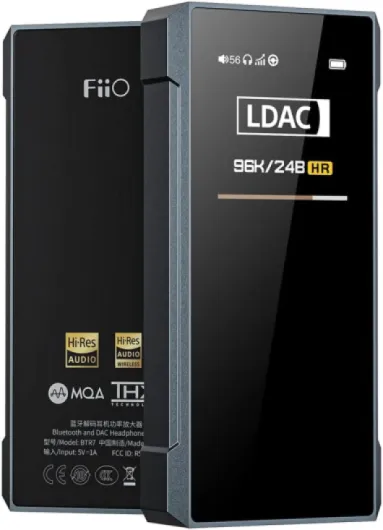
Design-wise, the BTR7 is closer to a small portable player than a tiny Bluetooth clip. It’s thicker and heavier than the older BTR5 or an iFi GO blu. You can still pocket it easily, but if you were hoping to clip it to your shirt and forget about it, the size and weight make that a bit awkward. I mostly kept it in a pants pocket or on the desk next to the laptop, and for that it’s fine.
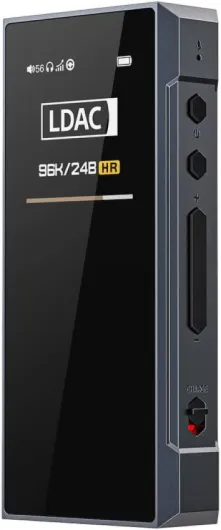
The layout is pretty logical once you learn it: power/menu button, multi-function play/pause/call button, volume rocker that also doubles for menu navigation, a physical charging on/off switch, and two outputs on top (3.5 mm single-ended and 4.4 mm balanced). USB-C sits at the bottom for charging and DAC use. There’s also a small color screen that shows codec, battery, volume, and basic settings. The screen is actually useful, not just a gimmick, but it’s small enough that you’re not going to be scrolling through long menus comfortably.
Controls are okay but not great. The buttons are small and have multiple functions depending on long-press, short-press, or when you’re in the menu. At the beginning I often triggered the wrong thing, especially when trying to change tracks versus volume. After a few days, muscle memory kicked in and it stopped being annoying. Still, compared to something super simple like a one-button dongle, there’s definitely more to think about.
Visually, the titanium finish looks nice and a bit more “premium” than plain black plastic, but I honestly don’t care much once it’s in the case. The included leatherette case is handy, though it adds a bit of bulk. I’d say the design is functional, slightly overbuilt for a Bluetooth dongle, and more targeted at people who don’t mind carrying a small brick if they get better sound and power out of it.
Battery life: decent but not a marathon runner
Battery life on the BTR7 is fine but not mind-blowing. In my use (Bluetooth LDAC, mixed gain levels, mostly 4.4 mm output, screen on and off a few times), I was getting roughly 6–8 hours before I started thinking about charging. If you run it at lower volume, single-ended output, and maybe AAC or aptX instead of LDAC, you can stretch it a bit more. But this is not an all-week device; it’s more like “charge every evening or every other day” if you use it regularly.
On USB DAC duty with a laptop, the behavior is a bit different. There’s a physical charging on/off switch that lets you decide if you want it to charge from the host device or not. This is actually pretty handy: you can stop it from draining your laptop battery, or you can let it top up while you work. When set to charge, it warms up a bit but nothing scary. Charge time from low battery to full is around a couple of hours with a decent USB charger.
Standby drain is moderate. If you forget to switch it off, it doesn’t die instantly, but it does slowly eat into the battery. Overnight with Bluetooth still paired but idle, I lost around 10–15%. Not tragic, but it’s better to shut it down if you know you’re done for the day. There’s no massive power-saving magic here; it’s just a regular battery in a fairly powerful little amp.
So if you were hoping for 15+ hours of heavy use, this isn’t it. For commuting, office, and casual home use, it gets the job done. If you’re on long-haul flights or all-day events, you’ll either need a power bank or you’ll want to plug it in via USB at some point. For me, battery life lands in the “acceptable, not a strong selling point, but not a deal-breaker” zone.
Build quality and long-term feel
The BTR7 feels solidly put together, especially compared to some flimsy dongle DACs I’ve used. The metal chassis doesn’t flex, the jacks feel firmly anchored, and nothing rattles. After throwing it in a bag and pockets with keys and other junk, the body picked up a few minor scuffs but nothing serious. The included case helps a lot here; I ended up leaving it on most of the time just for peace of mind.
The headphone jacks in particular feel more trustworthy than the ones on my old Dragonfly-style DAC, which eventually failed when the jack detached inside the casing. On the BTR7, plugging and unplugging headphones multiple times a day hasn’t caused any wobble or looseness so far. The buttons are small but clicky, and I haven’t had any sticking or double-press issues.
Heat-wise, it does get warm when pushing high gain over balanced output or when charging while playing, but it never got so hot that I worried about it. More like “warm phone while gaming” level. I wouldn’t leave it baking on a car dashboard in summer, but for normal indoor and pocket use it’s fine. The official spec says up to 50°C upper temperature rating, which seems realistic for typical environments.
Long term, the only things I’d keep an eye on are the battery (like any lithium cell, it will degrade over time) and the USB-C port, since that gets a lot of use if you do a lot of DAC duty. But overall, it gives the impression of a device designed to be used daily, not baby’d. It’s not indestructible, but it’s definitely sturdier than a lot of small plastic Bluetooth adapters I’ve tried.
Sound quality and power: drives real headphones, not just IEMs
On the sound side, the BTR7 is the first Bluetooth device I’ve used that actually feels comfortable driving 300-ohm headphones like the Sennheiser HD600/HD660S2 to decent levels. Using the 4.4 mm balanced output in high gain, I had volume headroom to spare and the sound stayed clean. No obvious hiss, no weird background noise, even during quiet passages. When nothing is playing, it’s basically dead silent, which is exactly what you want from a DAC/amp.
Compared to my older FiiO E10K and a Dragonfly-style dongle I used before, the BTR7 sounds clean and controlled. Bass is tighter, there’s good separation between instruments, and nothing jumps out as harsh or muddy. I’m not going to pretend I hear night-and-day differences with every track, but going back to my laptop’s headphone jack or a very cheap dongle is noticeable. It’s more obvious with better headphones and wired IEMs; cheap earbuds don’t show off the difference as much.
Over Bluetooth, using LDAC from an Android phone, the quality is close enough to USB that I didn’t feel shortchanged. I’m sure if you A/B test in a quiet room you might notice tiny differences, but in normal use (walking, on the couch, at the desk) it just sounds good and consistent. Codecs supported are generous: LDAC, aptX Adaptive, aptX HD, aptX LL, standard aptX, AAC, SBC. So pretty much whatever your phone can throw at it, it handles.
Is it on the same level as big desktop stuff like a Chord Mojo or a high-end desktop DAC/amp? No. The attack and overall slam you get from larger dedicated gear is still a step up. But for a Bluetooth device that fits in your pocket, the BTR7 holds its own. For me, the key thing is that it never felt weak or strained, even with more demanding headphones, and that’s already better than a lot of smaller Bluetooth dongles I’ve tried.
What you actually get and how it fits into a setup
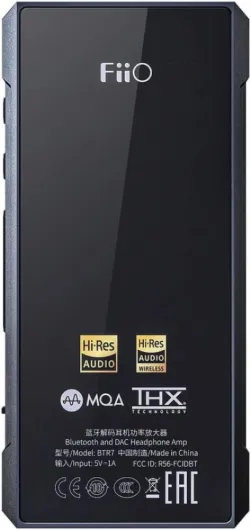
Out of the box, the BTR7 feels like a complete little kit. You get the unit itself, a leatherette case, a short USB-C to USB-C cable, and a USB-C to USB-A cable. That’s enough to plug it into most phones, tablets, and laptops without hunting for extra adapters. No silly extras, but also nothing obvious missing. For the price, I’d say the bundle is pretty solid and more generous than some competitors that throw in a bare cable and call it a day.
In terms of role, it’s basically three things in one: a Bluetooth receiver, a portable headphone amp, and a USB DAC for phone/PC. I used all three. Over Bluetooth from my phone (LDAC), it’s my walking-around setup. Over USB from my laptop, it replaces a cheap desktop DAC/amp. In the car, I tried feeding it into the AUX input to upgrade the car stereo. It handled these roles fine, but you do have to spend a bit of time at the start going through settings and firmware updates to get the best out of it.
One thing to note: as a Windows USB DAC, you usually need to install FiiO’s driver first. It’s not plug-and-play like some dongles. Once that’s done, it works reliably, but this is not a “hand it to your non-techy friend and it just works” type product. The menu and the FiiO app give you control over gain, filters, charging behavior, etc., but the interface is small and not super intuitive at first. I did need the manual for a few things, especially the dual-function buttons.
So in practice, the BTR7 is feature-rich but not idiot-proof. If you like tweaking and don’t mind a small learning curve, it’s fine. If you want pure simplicity, something like a basic BTR5-level device or a simple USB dongle might be less hassle. But once it’s set up, day-to-day use is mostly just power on, auto-connect, plug your headphones, and go.
Pros
- Plenty of power, especially from the 4.4 mm balanced output, can drive 300-ohm headphones decently
- Clean, quiet sound over both Bluetooth (LDAC/aptX HD) and USB DAC mode
- Good feature set: dual outputs, screen, wide codec support, USB DAC up to 384 kHz/DSD256
Cons
- Bulkier and heavier than many Bluetooth dongles, not ideal as a light shirt-clip device
- Battery life is only moderate (around 6–8 hours in real use, less with heavy LDAC/balanced use)
- Menu/software experience is a bit clunky and needs some learning and firmware updates
Conclusion
Editor's rating
The FiiO BTR7 is a capable, slightly chunky Bluetooth DAC/amp that does what it says without trying to be overly fancy. Sound quality is clean, it has enough power to handle real headphones (not just tiny IEMs), and the feature set is broad: LDAC and aptX variants, 3.5 mm and 4.4 mm outputs, USB DAC mode up to 384 kHz/DSD256, and even MQA if you care about that. In daily use, it feels like a solid upgrade from basic dongles or your phone’s output, especially if you own mid to high-end wired headphones.
On the downside, it’s not the most compact device, the menu system and app are a bit clunky at first, and battery life is only decent, not long-distance hero level. The built-in mic is usable but nothing special; it’s good enough for calls, but it won’t replace a good headset. If you want something feather-light to clip to your collar and forget, this might feel too big. If you’re super sensitive to software quirks, the initial setup and firmware update might annoy you.
I’d recommend the BTR7 to people who: use wired headphones a lot, want real power in a portable form, and appreciate having both Bluetooth and USB DAC in one box. It’s also a good pick if you’re tired of fragile dongle DACs hanging off your phone. If your use case is very simple (easy-to-drive IEMs, no balanced, no need for big power), you can save money and space with a smaller BTR5-type unit or a basic dongle. But if you sit in that middle ground of “I care about sound and versatility, but I still want something portable”, the BTR7 is a pretty solid option.