
Summary
Editor's rating
Value for money: solid feature set, but not flawless
Design: light, discreet, but clearly plastic
Battery life: the strong point, charging a bit slow
Comfort: very light on the head, but isolation is only average
Durability: light build that feels okay but not indestructible
Sound and mic performance: good, but needs EQ work
What the Arctis Nova 5 actually offers in real life
Pros
- Very long battery life (realistically 45–55 hours) with useful fast charge
- Light and comfortable for long gaming or work sessions
- Multi‑platform support with 2.4 GHz dongle and Bluetooth plus easy Quick‑Switch
Cons
- Sound is just average out of the box and really needs EQ/preset tweaking
- Mostly plastic build with average passive isolation and non‑premium feel
- Software is a bit confusing and required to get the most out of the presets

Specifications
View full product page →| Brand | SteelSeries |
A wireless headset that tries to do everything
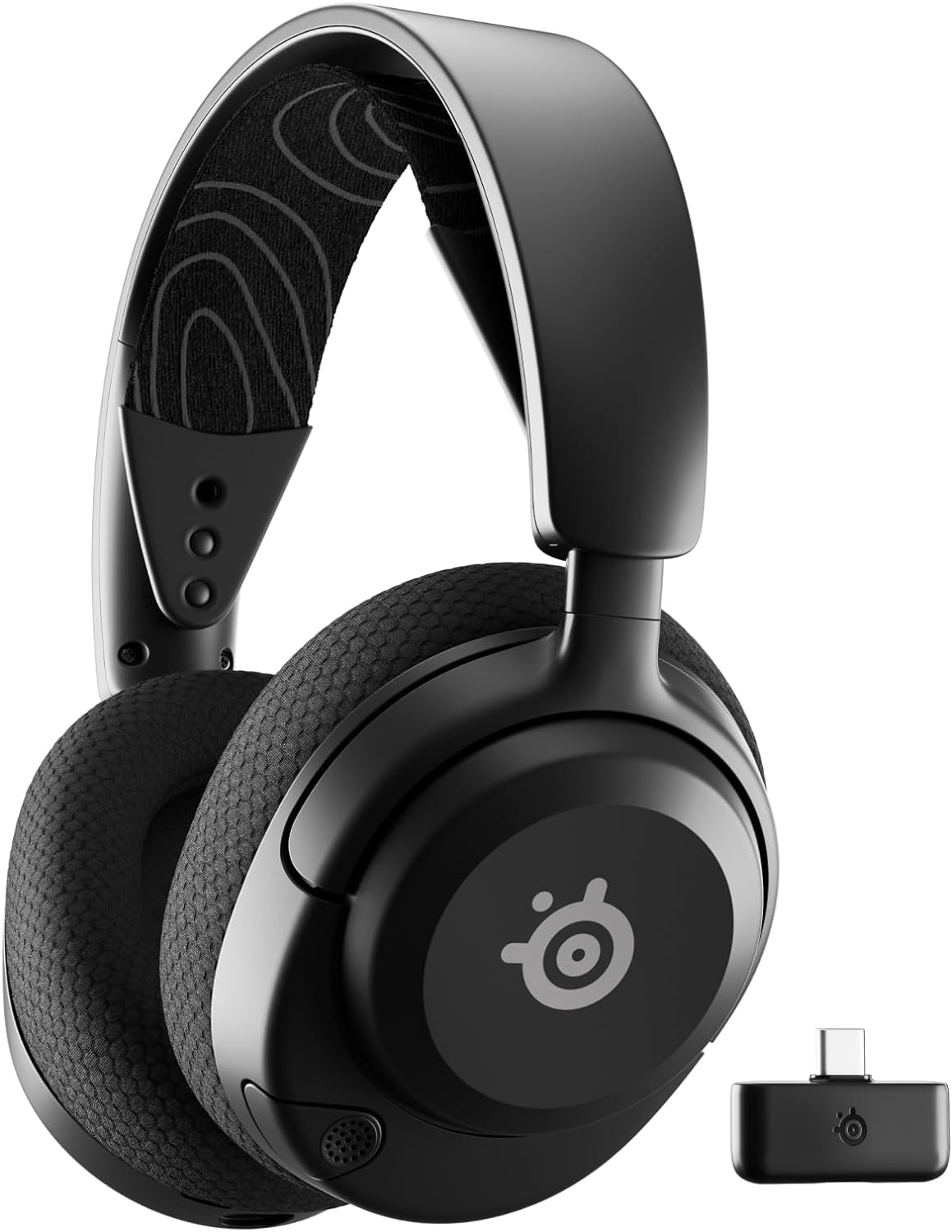
I’ve been using the SteelSeries Arctis Nova 5 Wireless for a while now, mainly on PC and PS5, with a bit of Switch and phone use on the side. On paper it ticks a lot of boxes: 2.4 GHz dongle, Bluetooth 5.3, 60‑hour battery, a retractable mic, and that big marketing pitch about 100+ audio presets. In real life, it’s a more down‑to‑earth story: some things are very good, some are just okay, and a couple of details are mildly annoying.
The first impression when you take it out of the box is that it’s light and pretty compact for an over‑ear gaming headset. It doesn’t feel like a tank, but it also doesn’t feel like a cheap toy. I went in a bit skeptical about the whole “audio preset” thing, because that usually sounds like a gimmick, and honestly, out of the box the sound is just fine but not mind‑blowing. Once I started playing with the EQ and presets though, it started to make more sense.
Most of my testing was on competitive shooters (Apex, Fortnite), some single‑player stuff, plus a lot of YouTube and Discord. I also tested the Bluetooth switching a lot, because that’s a key selling point: game on 2.4 GHz, calls and music on the phone. That part does actually work, but it’s not magic. You still have to fiddle with buttons and volume to get everything balanced the way you want.
If you’re expecting a high‑end audiophile headset, this isn’t it. If you want something light, wireless, and flexible that you can throw on your head every day for games, study, and calls, it’s honestly pretty solid. The main trade‑offs are the software, the average passive isolation, and a sound profile that really needs tweaking to shine. So it’s good, but you have to put in a bit of work to get the best out of it.
Value for money: solid feature set, but not flawless
Compared to other wireless gaming headsets in this price range, the Arctis Nova 5 offers a lot of features for the money: multi‑platform dongle, Bluetooth 5.3, long battery life, retractable mic, and a big pile of audio presets. The sound quality is good once tuned, the mic is more than decent for gaming and calls, and the comfort is clearly above average thanks to the low weight. If you want one headset that can handle PC, console, and phone without constantly unplugging cables, it’s a pretty practical option.
Where the value drops a bit is in the software and out‑of‑box experience. If you just plug it in and go, the factory EQ is okay but not great, and you don’t really benefit from the advertised presets. SteelSeries GG (on PC) and the companion app are usable, but not the most intuitive. It took me a bit of time to find a setup I liked and then basically ignore all the extra profiles. If you hate messing with settings and software, that’s something to consider.
Against competitors like Turtle Beach, Razer, and Logitech in the same bracket, I’d put this in the “pretty solid” category. The battery and comfort are better than many, the sound is competitive once you tweak it, but the plastic feel and average isolation keep it from feeling truly high‑end. For the current street price, I think it’s good value if you use several devices and care about battery life. If you only play on one platform and don’t care about Bluetooth or presets, you might find simpler wired or single‑platform wireless headsets that sound as good or better for less money.
So in terms of value: it’s not a steal, but it’s not overpriced either. It sits in a reasonable spot where you get a lot of flexibility and comfort, as long as you accept the trade‑offs and are willing to spend a bit of time tuning it to your taste.
Design: light, discreet, but clearly plastic
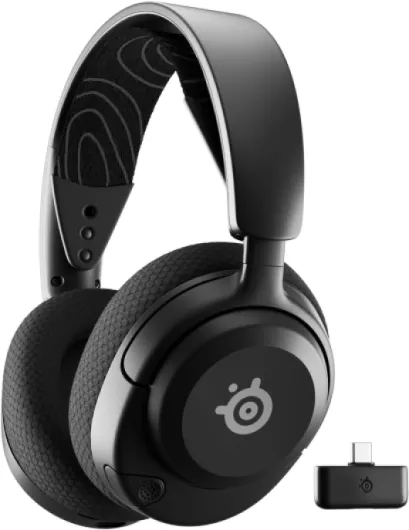
Design‑wise, the Arctis Nova 5 goes for the usual SteelSeries look: black, fairly minimal, no giant gamer RGB circus. If you wear it in a call or in a shared office, it doesn’t scream “streamer setup,” which I like. The earcups are round, with a matte finish that hides fingerprints decently. The headband is adjustable with the typical SteelSeries suspension system, and it does a good job of spreading the weight.
The downside is you can feel that most of it is plastic. It’s not flimsy, but it doesn’t feel premium either. If you’ve used more expensive headsets with metal frames (like higher‑end SteelSeries or Astro A50), you’ll feel the difference immediately. It’s light, which is good for comfort, but if you twist it in your hands you’ll hear a few creaks. I dropped it twice from desk height and nothing cracked, so in daily use it survives, but you won’t forget it’s a mid‑range product.
All the controls are on the headset, and that’s both practical and slightly crowded. On the earcup you get: power, volume wheel, mic mute, and the Quick‑Switch wireless button. After a couple of days I got used to where everything is, but at the beginning I often hit the wrong button while trying to mute or switch. The mic is fully retractable into the earcup, which is nice: when it’s hidden, the headset looks like normal headphones.
In terms of design, I’d sum it up like this: light, simple, and functional, but clearly plastic and a bit generic. It doesn’t feel fragile to the point of worrying, but if you’re rough with your gear or throw your headset in a bag every day, I wouldn’t expect it to age as well as something with a more solid frame. For home use on a desk, the design is totally fine and blends in easily.
Battery life: the strong point, charging a bit slow
Battery life is probably the part where this headset impressed me the most. SteelSeries claims up to 60 hours, and in real use I was consistently getting between 45 and 55 hours depending on volume and whether I was using Bluetooth at the same time. That’s still a lot. I could easily go through almost a full week of daily use (a few hours of gaming + music + calls) without needing to charge. Compared to older wireless headsets that barely last 15–20 hours, this is a clear step up in convenience.
The Fast Charge claim (about 6 hours of use from 15 minutes charge) is pretty accurate. I once forgot to charge it and plugged it in while grabbing a coffee; after 15–20 minutes, I had enough juice for a full evening of gaming. That’s genuinely useful. You can also use it while charging via USB‑C, which saves you from awkward silent sessions waiting for it to power up.
The downside: a full charge from almost empty still takes a while, around 3–4 hours in my case. It’s not a big deal since you rarely run it all the way down if you plug it in occasionally, but if you let it die completely and then remember just before a long session, you’ll either rely on fast charge or wait. There’s no fancy charging dock here like with some more expensive headsets; it’s just a cable, which is simple but not as convenient if you like having a fixed charging spot.
Overall, the battery is one of the main reasons to pick this model. You basically forget about charging for days, and that’s nice. If you’re the type who hates plugging in devices all the time, this is a good fit. Just accept that a full charge isn’t super fast, and plan to top it up now and then instead of running it to 0% every time.
Comfort: very light on the head, but isolation is only average
The big strength of this headset for me is comfort over long sessions. It’s very light (around 280 g), and you really feel that compared to heavier wireless headsets. I’ve done 4–5 hour sessions on PC and it never felt like a clamp around my skull. The clamping force is on the lighter side, which is good if you don’t like tight headsets, but that also plays a role in the weaker passive noise isolation.
The ear cushions are made of a kind of fabric with memory foam. They’re breathable, so your ears don’t roast after an hour, which I appreciate. On the flip side, the fabric is a bit scratchy compared to softer leatherette pads. It’s not painful or anything, but you feel the texture when you first put them on. After a couple of days, I stopped noticing, but it’s not the softest pads I’ve tried. The good news is they are easy to replace, and there are third‑party options if you want something softer or thicker.
If you’re in a noisy environment (roommates, kids, TV in the background), don’t expect miracles. Despite the specs mentioning “active noise cancellation”, in day‑to‑day use it feels more like basic passive isolation. You still hear a fair amount of outside noise. For me, it was fine: I could still focus on games and work, but compared to closed‑back headsets with tighter seal, this is clearly weaker. On the positive side, because isolation isn’t super strong, you also don’t get much ear pressure or that “underwater” feeling.
Overall, in terms of comfort I’d say: great for long hours, especially if you hate heavy headsets, but not the best if you need strong isolation. For a typical home gaming setup or studying with some background noise, it gets the job done. If you’re in a very loud place or want to fully block out the world, you’ll probably want something with better sealing pads or real ANC.
Durability: light build that feels okay but not indestructible
In terms of durability, my impression is that the Arctis Nova 5 is good enough for normal use, but not built like a tank. The plastic frame keeps it light, but you can tell it’s not something you want to bend aggressively or throw into a backpack without care. I’ve had a couple of accidental drops from desk height onto a hard floor, and so far no cracks, no rattles, and nothing loose, which is reassuring.
The headband adjustment still feels tight after repeated adjustments, and the earcups don’t show any worrying play or wobble. The finish on the plastic hasn’t scratched easily for me, but if you toss it around with keys or metal objects in a bag, I wouldn’t be shocked to see marks. It’s not water resistant, so don’t expect it to survive rain or spilled drinks. Sweat hasn’t been a problem during long sessions, but I wouldn’t use it at the gym or outdoors in bad weather.
The ear pads are usually the first weak point on headsets. Here, they seem fine for now, but the fabric texture makes me think they might pill or wear a bit faster than leatherette if you use them every single day. The good part is they are easy to replace, and there are third‑party pads everywhere, so even if they wear out after a year or two, it’s not the end of the world.
If you’re careful with your gear and mainly use it at a desk or on the couch, I think it will last several years without major trouble. If you’re rough on your stuff, throw it in bags, or share it with kids who twist and pull everything, I’d be a bit more cautious. In short: durable enough for normal adult use, but don’t expect hardcore ruggedness.

Sound and mic performance: good, but needs EQ work
Out of the box, the sound is decent but nothing more. The default profile is a bit flat in the mids with slightly sharp highs. For casual listening it’s okay, but when I first jumped into Apex and Valorant, footsteps and directional cues weren’t as clear as I expected. Once I opened the SteelSeries software and played with the EQ and game presets, it got a lot better. Boosting the high‑mids and trimming the harsh treble made a clear difference for me.
The 100+ audio presets are a mixed bag. Some are actually useful, especially the ones focused on competitive games where they bring out footsteps and reduce low‑end rumble. Others feel overdone, with too much bass or weirdly scooped mids. After testing a bunch, I ended up with one custom EQ that I use for almost everything and ignore most of the rest. So the feature is nice to have, but it’s not as magical as the marketing suggests: you still need to tune it to your taste.
For music, it’s fine for a gaming headset. Bass is present but not super punchy, mids are okay, and highs can get a little sharp at higher volume. If you’re used to dedicated music headphones, you’ll notice the difference, but for Spotify, YouTube, and Netflix, it’s totally acceptable. The soundstage is decent for an over‑ear wireless headset: positional audio in games works, you can tell where shots and footsteps come from, but it’s not on the level of high‑end open‑back headphones.
The mic is better than I expected for this price range. On PC and PS5, teammates told me I sounded clear and natural, not like a tin can. It’s not studio quality, but for Discord, in‑game chat, and work calls, it’s more than enough. The only issue I noticed is that the mic volume can be a bit low on some platforms (especially phones), and you sometimes need to boost it in software. Also, don’t expect great noise rejection in a loud room; keyboard and background noise still come through. Overall, for gaming and general use, the performance is pretty solid once you take the time to set it up properly.
What the Arctis Nova 5 actually offers in real life
On the spec sheet, the Arctis Nova 5 Wireless is packed: 2.4 GHz wireless via USB‑C dongle, Bluetooth 5.3, up to 60 hours of battery, and a so‑called ClearCast Gen 2.X mic that promises better clarity. In reality, the basics are covered well: the dongle works on PC, PS5, PS4, Switch, and basically anything with USB‑C (or USB‑A using the included extension). Bluetooth pairs quickly with phones and tablets, and switching between the two radios is done with a dedicated button on the headset.
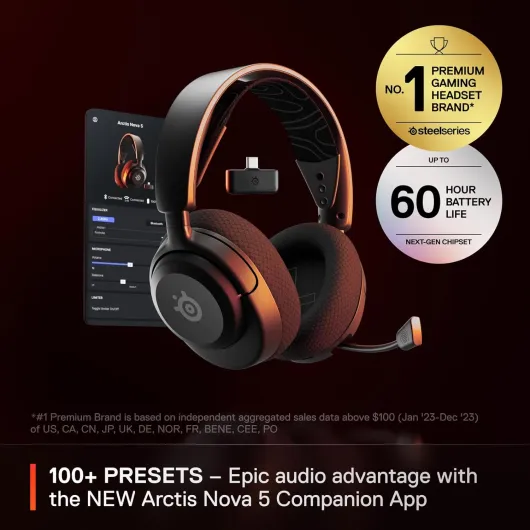
SteelSeries pushes the 100+ game audio presets a lot. To be clear: you don’t get magic sound out of the box. You need the app (Nova app on mobile or SteelSeries GG on PC) to really dig into those profiles. They’re named for games like Fortnite, Apex, GTA V, CoD, etc. Some are useful (footsteps boosted, dialogue clearer), some feel like overkill. The good part is you can save your own EQ and just ignore the noise once you find what works.
Connectivity is where the headset makes more sense. I used the dongle on my PC and paired Bluetooth with my phone. I could be in a Discord call on PC, then tap the Quick‑Switch button to answer a phone call without taking the headset off. Notifications beeping in my ear while gaming is nice but can be slightly distracting if you get a lot of messages. The Bluetooth range is decent; I could walk to the kitchen without cutting out, but not as far as some people claim unless you have thin walls.
Overall, from a pure feature standpoint, it’s a very complete mid‑range gaming headset. It doesn’t feel like a toy, it supports all the main platforms, and it doesn’t lock you to one ecosystem. Just be ready to spend a bit of time in the software and don’t expect miracles from the presets alone. The features are there, they work, but they’re not as plug‑and‑play and magical as the marketing suggests.
Pros
- Very long battery life (realistically 45–55 hours) with useful fast charge
- Light and comfortable for long gaming or work sessions
- Multi‑platform support with 2.4 GHz dongle and Bluetooth plus easy Quick‑Switch
Cons
- Sound is just average out of the box and really needs EQ/preset tweaking
- Mostly plastic build with average passive isolation and non‑premium feel
- Software is a bit confusing and required to get the most out of the presets
Conclusion
Editor's rating
Overall, the SteelSeries Arctis Nova 5 Wireless is a solid all‑round gaming headset that shines mainly on comfort, battery life, and flexibility. If you jump between PC, PlayStation, Switch, and your phone, it’s very convenient to have one headset that handles everything via the USB‑C dongle and Bluetooth. The Quick‑Switch function to jump from game audio to phone calls actually works in daily life, and the 60‑hour battery means you’re charging it far less often than many rivals. For long sessions, the low weight and breathable pads are a real plus.
On the other hand, it’s not perfect. The sound out of the box is just okay and really benefits from EQ tweaks and experimenting with presets. The construction is mostly plastic and doesn’t feel premium, even if it holds up fine for normal use. Passive isolation is average, and the software is a bit clunky if you’re not used to this kind of thing. The mic is good for gaming and calls, but not at the level of a dedicated desktop mic.
If you want a light wireless headset with long battery life that you can use on pretty much everything, and you don’t mind spending some time tuning audio settings, this is a good pick. If you want maximum isolation, a more premium build, or plug‑and‑play sound that’s great without touching any software, you might be happier with something else, even if it means losing some of the Nova 5’s flexibility.