
Summary
Editor's rating
Is it worth the money compared to other options?
Tiny, light, and slightly fiddly to use at first
Battery life and charging: good, but not endless
Using it daily: ergonomics, headphones, and real-world annoyance level
Build quality and how tough it feels
Sound quality: very good for headphones, with some quirks
What this thing actually does (and doesn’t do)
Pros
- Lots of usable amp and effect models in a very compact format
- Bluetooth streaming makes jamming to songs and lessons simple
- Good overall sound quality for headphones, especially on higher-gain tones
Cons
- Interface can feel cramped and a bit confusing until you learn it
- Edge-of-breakup and super dynamic tones still lag behind a real tube amp

Specifications
View full product page →| Brand | Fender |
A tiny box that replaced my practice amp… mostly
I’ve been using the Fender Mustang Micro Plus for a few weeks now, mainly for late-night practice and messing around on the couch. I play mostly rock and blues, with a bit of metal, and I was getting tired of dragging a combo amp and a couple of pedals around the house just to play quietly. I wanted something that I could just plug straight into the guitar, throw on headphones, and not annoy anyone. This thing fits that use case pretty well.
In day-to-day use, the big thing is how quick it is to get going. I plug it into the guitar, plug in my headphones, pick a preset, and I’m playing in under 30 seconds. No cables on the floor, no fiddling with a pedalboard, no worrying about volume. It sounds simple, but it actually changed how often I pick up the guitar during the day. I grab it for 10–15 minute breaks way more than before.
It’s not perfect though. The interface is a bit cramped, and if you don’t use the app or at least read the manual once, you’ll be guessing what some things do. Also, if you’re picky about feel and dynamics, you’ll notice that it’s still a digital unit: cleans and edge-of-breakup tones are decent but not as responsive as a real tube amp. High gain stuff is where it feels more at home.
Overall, as a practice tool, it gets the job done really well. I wouldn’t use it as my main tone for recording or gigs, but for silent practice, learning songs from YouTube via Bluetooth, and trying different amp flavors without buying a pile of gear, it’s pretty solid. Think of it as a very convenient, good-sounding practice shortcut, not as a full replacement for a real amp setup.
Is it worth the money compared to other options?
Price-wise, the Mustang Micro Plus sits in the higher end of headphone amps, but it’s still cheaper than buying a small modelling amp plus a separate multi-FX. You’re paying for convenience and the fact that you get 25 amps, 25 effects, Bluetooth, a tuner, and 100 presets in something that fits in a pocket. If you actually use the features—different amp models, effects, Bluetooth backing tracks—then the value is pretty good.
Compared to cheaper headphone amps that give you just a few basic tones and no Bluetooth, this feels like a more complete practice solution. You can explore different types of amps (Fender, Marshall-style, modern metal, etc.) and effects without buying a bunch of pedals. If you’re the kind of person who likes to test different sounds before spending real money on big gear, this is a handy test bed. I’ve already found one or two amp "flavors" I might chase in real life later.
On the flip side, if you only want a simple clean tone to practice scales and don’t care about effects or Bluetooth, there are cheaper units that will get the job done. Also, if you already own a decent audio interface and like using plugins on your computer, you might feel you’re paying for some overlap. The big difference is that this doesn’t require a computer or any setup: it’s self-contained.
Taking everything into account—sound quality, features, build, and real-world usefulness—I’d say it’s good value for money for players who practice a lot and want a compact, flexible tool. It’s not the bargain of the century, but you do get a lot of functionality in return. If your budget is tight and you don’t care about all the bells and whistles, you might find it a bit pricey. If you value silent practice and tone variety, it’s a reasonable investment.
Tiny, light, and slightly fiddly to use at first
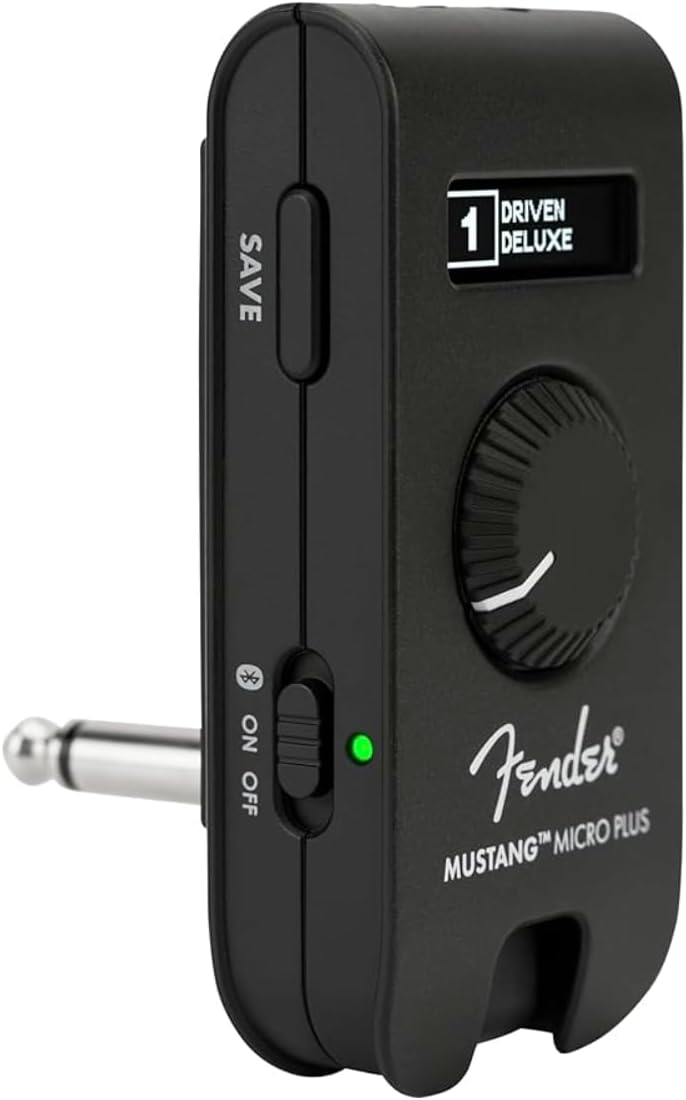
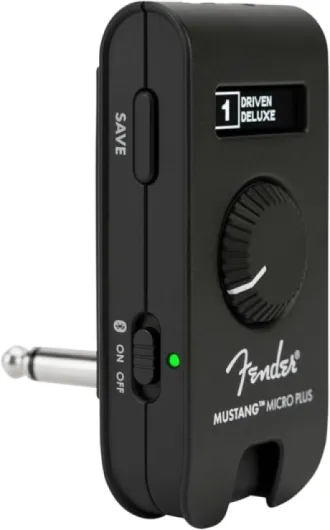
Physically, the Mustang Micro Plus is very compact: roughly a small matchbox size (around 3.15 x 1.5 x 1.21 inches) and about 7 ounces. It hangs directly off your guitar’s output jack using its built-in plug. The good news: it’s light enough that it doesn’t feel like it’s going to snap your jack off. I’ve used it on a Strat-style side jack and a Les Paul-style front jack without any major issues. It does stick out, so if you play sitting on a couch and lean the guitar into your body, you need to be a bit aware of it so you don’t knock it around.
The integrated display is a big plus compared to the older style units that only use colored LEDs. You can actually see what preset number you’re on and roughly what you’re adjusting. It’s not a fancy screen, but it’s enough to avoid guessing. The buttons and controls are small but manageable. After a couple of days, I knew where everything was by feel. That said, if you have big hands or hate small buttons, you might find it slightly annoying to tweak things directly on the unit.
One detail I liked is the angled jack. It helps it sit a bit closer to the body of the guitar instead of sticking straight out. This makes it less likely to snag on stuff. Also, the USB-C port is on the bottom edge, which is handy for charging while using it, but you still need to be careful not to bend the cable if you’re sitting in a weird position. Overall, the layout is fairly logical once you get used to the button combinations.
The downside on design is mainly about interface depth vs. size. There’s a lot packed into this tiny thing: 25 amps, 25 effects, tuner, presets, Bluetooth, etc. Navigating all of that through a few buttons and a small display isn’t exactly intuitive the first day. It’s not a deal-breaker, but don’t expect plug-and-play simplicity like a single-knob headphone amp. Plan to spend an evening learning how to move around menus and maybe using the app to set up your main tones so you don’t have to dig too deep on the hardware afterwards.
Battery life and charging: good, but not endless
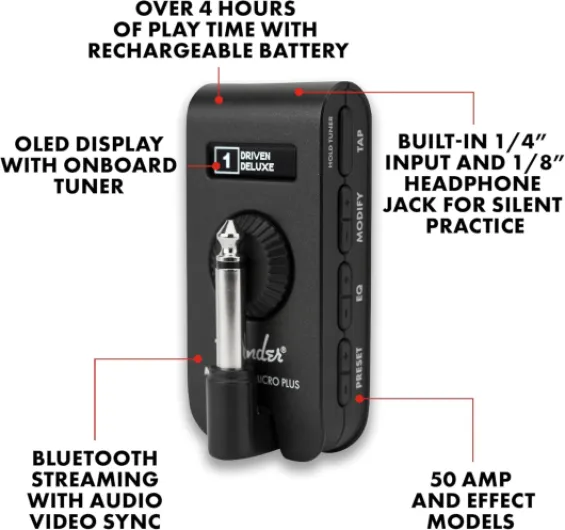
The Mustang Micro Plus runs on a built-in rechargeable lithium-ion battery, charged via USB-C. In real use, I got roughly 4–6 hours of playing on a full charge, depending on how loud I ran my headphones and whether I had Bluetooth streaming going the whole time. With only guitar and no Bluetooth, it leans closer to the higher end. With Bluetooth backing tracks constantly, it drains a bit faster. Either way, for a normal evening of practice, it’s more than enough.
Charging is straightforward: plug it into any USB-C charger (phone charger, laptop port, power bank). From low to full, it took me about 1.5–2 hours to charge. The nice part is that you can use it while it’s charging, so even if you forget to charge it and it dies mid-session, you can plug it in and keep going. I ended up leaving a short USB-C cable near the couch just in case, and that solved the problem of forgetting to top it up.
There’s an indicator on the display that helps you see battery status, but it’s not ultra-detailed. You get a rough idea rather than a precise percentage. In practice, I just got used to plugging it in every couple of days. For something this size, I think the battery life is acceptable. It’s not like wireless headphones that last 20+ hours, but it’s also doing amp modelling and Bluetooth streaming, which eats more power.
The only downside is that if you’re the kind of person who forgets to charge things, you can get caught with a dead unit when you want to play. There’s no removable battery, so you can’t just swap in a spare. If that’s a big concern, keep a power bank in your guitar case. For most people, I think the combo of 4–6 hours of use and USB-C charging is perfectly fine for a practice gadget.
Using it daily: ergonomics, headphones, and real-world annoyance level
Comfort with a product like this is less about how it feels in the hand and more about how it fits into your routine. Plugging it straight into the guitar is genuinely convenient. No dangling cables from the guitar to a floor unit. The guitar, the Mustang Micro Plus, and your headphone cable are the only things in play. For couch practice or sitting at a desk, that’s a big plus. I found myself picking up the guitar more often just because setup time dropped to almost nothing.
How comfortable it is also depends on your headphones. With lightweight wired over-ears or in-ears, it’s great. With big heavy studio cans, the overall experience is still fine, but you do feel more "tethered". Personally, I preferred in-ears for longer sessions because the cable is lighter and doesn’t pull as much. The 3.5mm jack on the unit feels solid; I didn’t notice crackling or loose connection issues once the plug was seated properly.
One small annoyance is the position of the unit on certain guitars. On a Strat-style output jack, it sits at an angle and is mostly out of the way. On a Les Paul-style front jack, it sticks out from the front and can bump into your leg if you sit in certain positions. It’s not a deal-breaker, but you’ll probably tweak your playing posture a bit to avoid hitting it. Standing up with a strap, it’s barely noticeable.
From a mental comfort perspective, the biggest win is the silent practice factor. I can practice late at night, work on riffs, and loop the same part 20 times without thinking about neighbors or family. That alone makes a difference. The only thing that slightly breaks the comfort flow is when I want to deep-edit a preset on the unit itself. Doing lots of tiny button presses while holding a guitar isn’t super fun, so I tend to do that once, save a few good presets, and then just cycle through them. Once you’ve done that setup, day-to-day use is very comfortable and low-friction.
Build quality and how tough it feels
The unit is mostly plastic, which at first made me a bit skeptical. But after actually using it, it feels more solid than it looks in photos. The plastic doesn’t feel thin or cheap, and the buttons have a decent click to them. I’ve tossed it into a gig bag pocket, into a backpack, and left it on a desk where it got bumped around a bit, and it hasn’t shown any signs of cracking or loosening so far.
The most important part for durability is the built-in jack, because that’s the piece that takes the most stress. On my guitars, it felt snug but not overly tight, and I didn’t feel any wobble. Of course, if your guitar’s jack is worn out or loose, you might run into noise or fit issues, like some people mentioned in reviews. That’s more on the guitar than the unit itself, but it’s worth checking. If your jack is already flaky with other cables, fix that first.
The USB-C port and the headphone jack both feel reasonably sturdy. I wouldn’t yank cables sideways or step on them (obviously), but normal use hasn’t caused any problems. The finish hasn’t scratched easily in my case, though it will probably show marks over time if you’re rough with it. It’s still a small, plastic electronic device – I wouldn’t throw it at a wall or drop it from height and expect it to survive.
One reassuring point is the 2-year warranty from Fender. It doesn’t make it indestructible, but it gives a bit of peace of mind if something fails early. Overall, I’d rate durability as good for what it is: a portable practice gadget. It’s not built like a heavy-duty metal stompbox, but it feels sturdy enough for daily use, travel, and being tossed in a bag, as long as you use a bit of common sense.
Sound quality: very good for headphones, with some quirks
Let’s talk about what matters most: how it sounds. Through a decent pair of wired studio headphones, the Mustang Micro Plus sounds pretty solid. Clean tones are clear and not overly harsh, especially if you pick the more "amp-like" presets and roll the treble back a bit. The higher-gain amps are where it shines more. Palm-muted riffs, leads with delay, and modern rock tones feel tight and satisfying for a headphone unit. Compared to practicing through a cheap practice amp at low volume, I honestly prefer this in the ears.
Where it’s a bit weaker is that edge-of-breakup / crunchy zone. Like many digital units, that subtle in-between area where the sound cleans up with picking dynamics is not as natural as a good tube amp. You can still get usable crunch tones, but if you’re very picky about how the amp responds to your picking and volume knob, you’ll feel the difference. For me, for practice, it’s totally fine, but I wouldn’t expect it to feel like a cranked Deluxe Reverb or Marshall.
The effects are more than enough for practice. Reverbs and delays sound good, modulation is decent, and you can get some fun ambient sounds if you like that. I wouldn’t say they’re on the level of high-end dedicated pedals, but that’s not really the point. They’re there to make practice more fun and to let you try out different effect types: chorus, flange, reverb, delay, etc. Noise-wise, it’s pretty quiet. You get some hiss on high-gain patches, but nothing crazy, and there’s usually a gate in those presets anyway.
One thing I liked is the Bluetooth audio mix. Jamming along to YouTube lessons actually feels quite natural. The guitar sits well in the mix and you can adjust levels so backing tracks don’t drown you out. Latency is low enough that I didn’t have any timing issues. I wouldn’t use Bluetooth for critical recording, but for practice it’s totally fine. Overall, for what it is—a headphone practice solution—the performance is strong. It won’t replace a real amp for tone purists, but it easily beats the "dry guitar into audio interface with free plugin" experience in terms of simplicity and fun.
What this thing actually does (and doesn’t do)
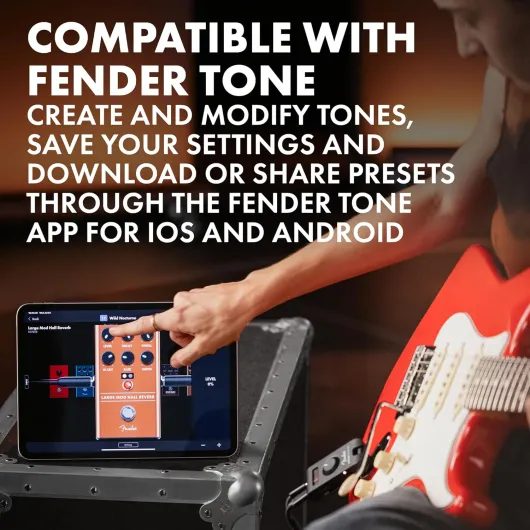
The Mustang Micro Plus is basically a tiny multi-effects and amp modeller that plugs straight into your guitar’s jack. No cables, no external power brick. You get 25 amp models and 25 effects, and up to 100 preset slots that you can edit, especially if you use the Fender Tone app. Compared to older simple headphone amps that give you 3–4 tones, this one is much closer to a pocket version of a modelling amp. You scroll through factory presets or make your own, and it stores everything onboard.
In practice, I mostly used 6–8 tones: a couple of cleans, a crunchy rock sound, a couple of higher-gain rhythm tones, and one lead patch with delay and reverb. The rest is nice to have, but like any multi-FX, you end up with favorites. The unit covers a wide range: there are Fender-style cleans, Marshall-ish crunch, modern high-gain, plus some bass and probably a few more niche amp types. If you like exploring gear, it’s fun. If you just want plug-and-play, you’ll need to pick a few presets and stick to them.
Besides the amps and effects, you also get Bluetooth audio streaming. That means you can stream backing tracks, Spotify, YouTube lessons, whatever, straight into the unit, and hear everything mixed in your headphones. Latency for me was fine for practice; I didn’t feel like the audio lagged behind my playing in a way that bothered me. It’s not meant for super-precise studio work, but for jamming along to songs, it’s totally usable.
Important to understand: this is not an amp you plug into a speaker cabinet. It’s a headphone amp. The 100W in the spec sheet is not what you think; you’re not running a band rehearsal off this. It’s for personal practice. You also can’t really expect it to replace a full-on modelling floorboard for live use. It’s mainly for quiet playing, learning, and experimenting with tones without setting up a whole rig.
Pros
- Lots of usable amp and effect models in a very compact format
- Bluetooth streaming makes jamming to songs and lessons simple
- Good overall sound quality for headphones, especially on higher-gain tones
Cons
- Interface can feel cramped and a bit confusing until you learn it
- Edge-of-breakup and super dynamic tones still lag behind a real tube amp
Conclusion
Editor's rating
After using the Fender Mustang Micro Plus regularly, I see it as a very practical tool rather than some magical solution. It gives you a wide range of usable tones, decent effects, Bluetooth for backing tracks, and a tuner, all in a device that lives on your guitar. For quiet practice, learning songs from YouTube, or messing around on the couch, it works really well and makes it easier to actually pick up the guitar and play. The sound is good enough that practice feels enjoyable, especially on higher-gain tones, and the overall experience is much less hassle than a full amp-and-pedal setup.
It’s not perfect: the interface can feel cramped, edge-of-breakup tones aren’t as natural as a real amp, and the price is higher than basic headphone amps. If you’re a tone purist or mainly care about recording quality, you’ll probably still prefer real amps or a more serious modeller into monitors. But if you’re a beginner to intermediate player who wants more than just a dry clean sound, or an experienced player who needs a solid silent-practice rig, it’s a strong option. I’d recommend it to anyone who practices often at home, travels with a guitar, or wants to explore different amp styles without buying a pile of gear. If your budget is tight and you only need a bare-bones headphone solution, you can go cheaper, but you’ll lose a lot of the flexibility that makes this unit actually useful day to day.