
Summary
Editor's rating
Good value for studio and desk use, less so for pure mobile use
Old-school studio look with some practical quirks
Very comfortable for long sessions once the clamp eases up
Solid build with replaceable parts, but that fixed cable hurts
Built to survive daily studio use, with one obvious weak point
Clear, punchy sound with good isolation, but needs proper power
What you actually get and how they fit into a setup
Pros
- Comfortable velour pads and light feel, good for long sessions once broken in
- Clear, punchy sound with good detail and decent isolation for recording and monitoring
- Sturdy build with many replaceable parts (pads, headband), suitable for long-term use
Cons
- Fixed, non-detachable cable that’s long and inconvenient for portable use
- 80 Ohm version needs a decent source or DAC/amp to sound its best, weak from phones
- Bulky, non-folding design and strong initial clamp make it poor for wearing around the neck or travel

Specifications
View full product page →| Brand | beyerdynamic |
Closed-back classic that’s everywhere in studios
I’ve been using the beyerdynamic DT 770 Pro 80 Ohm (grey version) for a while now, both at home and in a small project studio. These headphones have a big reputation in audio circles, so I was curious to see what they’re actually like in normal, day-to-day use. Not spec sheets, not hype, just how they feel when you grab them off the desk every day.
I mostly used them for recording vocals, guitar, a bit of mixing, plus some gaming and YouTube at night. I plugged them into a basic audio interface on my PC and sometimes straight into a laptop and phone. So this is not a "perfect room, perfect gear" situation – it’s more like a regular home setup where you want something reliable that doesn’t fall apart or sound weird after an hour.
Overall, they sound good and feel solid, but they’re not perfect. There are a few things I really liked: the comfort, the isolation, and the clarity. And there are a couple of things that bugged me: the fixed cable, how they behave on weak devices, and the clamp when you first get them. If you’re on the fence between these and other studio headphones like Audio-Technica M50x or Sennheiser HD 5xx, those details matter.
I’ll go through the design, comfort, sound, durability and value in a straight way. No fancy audiophile poetry – just what stood out in real use, and where I think you might be better off with another version (32 Ohm, 250 Ohm) or even a different model depending on how you plan to use them.
Good value for studio and desk use, less so for pure mobile use
For the price these usually go for, I’d put the DT 770 Pro 80 Ohm in the “good value, but not unbeatable” category. You’re paying for a sound that’s been used in studios for decades, solid comfort, and a build that can be maintained over time. If you’re doing any kind of home recording, streaming, or serious listening at a desk, they make sense as a main pair of closed-back headphones.
Where the value starts to get a bit more complicated is when you factor in what you actually need to run them properly. If you don’t have a decent audio interface, DAC, or amp, and you’re buying the 80 Ohm version, you might end up spending extra just to drive them well. At that point, you have to ask yourself if it wouldn’t be simpler to get the 32 Ohm version, or even a different pair that’s more portable and phone-friendly if studio work is not your main goal.
Compared to something like the Audio-Technica M50x, the DT 770 Pro gives you better comfort over long sessions and a bit more spacious, airy feel in the highs, while the M50x has a more portable design with a detachable cable and folding cups. If you’re mostly at a desk, I’d lean toward the DT 770. If you travel a lot, the M50x or similar designs might give you more practical value even if the comfort is a bit lower.
So overall, the DT 770 Pro 80 Ohm is a good deal if you use it the way it was meant to be used: plugged into a proper source, mainly at a desk or in a studio. If you’re hoping for one headphone that does studio work, portable use, and couch listening off a phone with no extra gear, the value is less clear, and you might be better off with the 32 Ohm version or a different model entirely.
Old-school studio look with some practical quirks
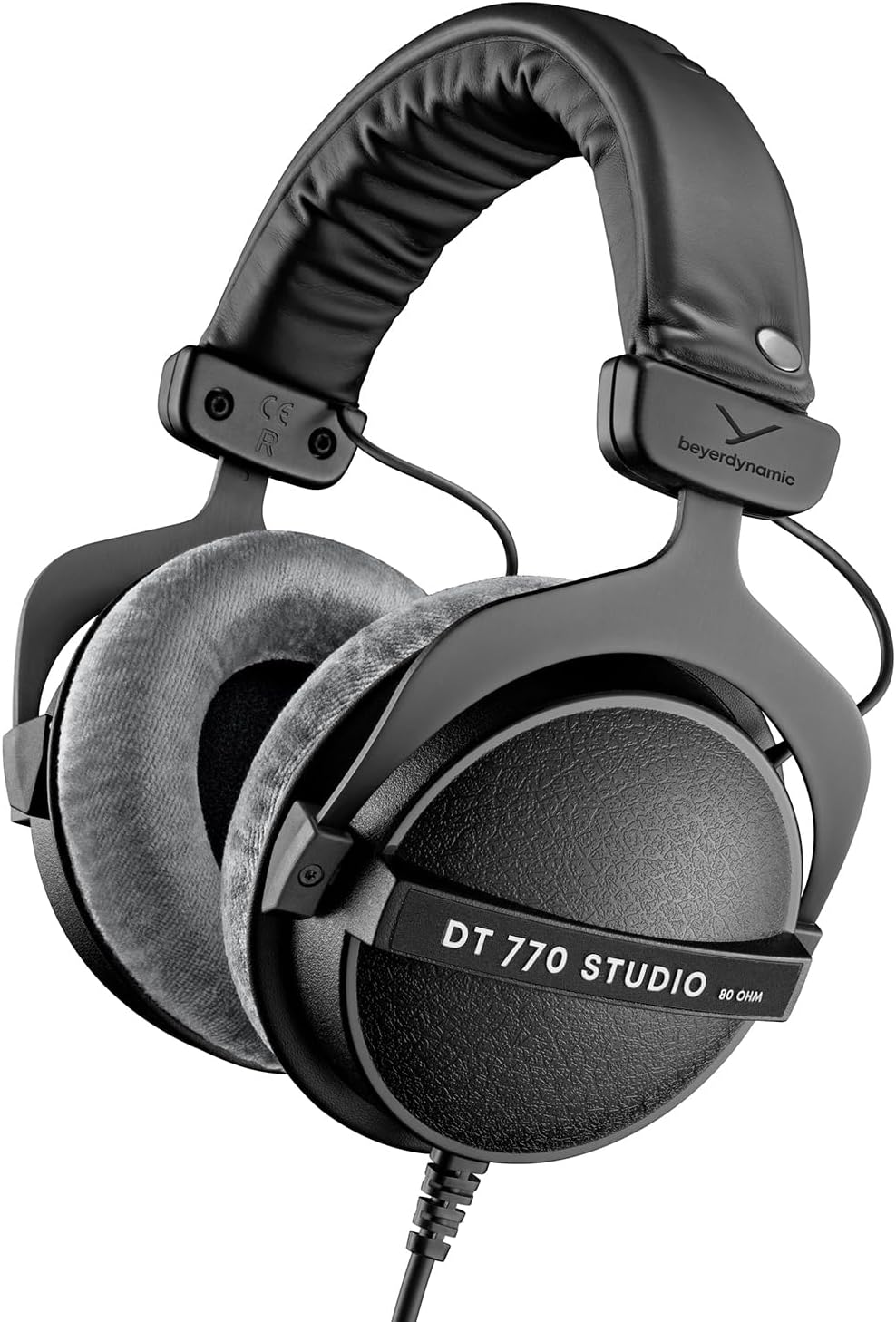
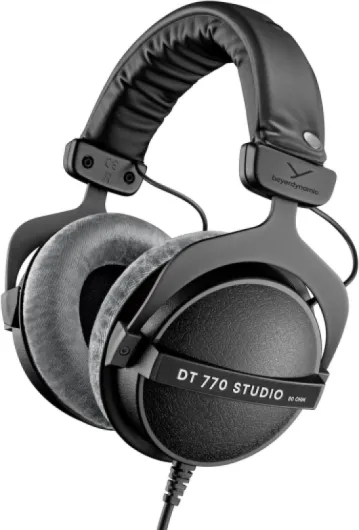
Design-wise, the DT 770 Pro 80 Ohm look like what they are: studio tools from a brand that hasn’t tried to chase modern “lifestyle” trends. Grey cups, metal headband, chunky yokes, and those signature velour pads. Personally, I don’t mind the dated look – it actually helps, because you stop thinking about them as a fashion item and more like a work tool. But if you care a lot about sleek or flashy design, these will feel a bit plain and old-school.
The earcups are made from hard plastic and the headband is a metal strip wrapped in a padded cover. The yokes feel solid and move with enough resistance that they don’t flop around. Adjustment is simple: you slide the cups up and down on the metal arms until they fit. There are no fancy hinges or folding mechanisms. That’s good for durability, but it also means they take up space in a bag and sit awkwardly around your neck. I tried wearing them around my neck a few times between takes, and the cups press into your jaw and collarbones in a slightly annoying way.
One thing that bothered me is the non-detachable cable. It’s a straight, thick cable that’s quite long, which is nice at a desk, but not so nice if you want to move around or use them on the sofa. You’re always managing this snake of a cable. And if the cable ever fails, you can’t just swap it out easily like with some modern models. For a pair that markets replaceable parts and long life, a fixed cable feels like a weak point.
On the positive side, the design is very stable on the head. Once you set the size, it stays there. The clamping force is firm out of the box, which helps with isolation, but it can feel tight at first. After a week or so of use – and gently stretching them over a box when I wasn’t using them – they loosened up to a more comfortable level. So the design is function-first, a bit bulky and old-school, but clearly thought out for studio use rather than fashion or portability.
Very comfortable for long sessions once the clamp eases up
Comfort is one of the main reasons people stick with the DT 770 Pro, and I get why. After the first couple of days, these turned into my “default” headphones when I knew I’d be wearing something for hours. The earcups are deep enough that my ears don’t touch the drivers, and the velour pads feel more like earmuffs than typical headphones. For long editing or gaming sessions, that makes a big difference.
Out of the box, though, the clamp is a bit strong. The first few sessions, I definitely felt pressure on the sides of my head after about an hour. Not painful, but noticeable. I ended up stretching them a bit by leaving them on a shoebox overnight for two or three nights. After that, the pressure eased up and they hit a nice middle ground: enough clamp to keep a good seal and stay in place, but not so much that you’re counting down the minutes until you can take them off.
Weight-wise, they feel light enough that you kind of forget about them after a while. No neck strain, no top-of-head hotspot. The only time they got slightly warm was on very long sessions (3+ hours) in a hot room, but that’s pretty normal for closed-back designs. Compared to something like the Audio-Technica M50x, I found the DT 770 more comfortable over time because of the deeper cups and softer pads. With the M50x my ears touch the inside a bit; with the 770, they sit comfortably inside the cup.
One thing to note: they are not comfortable to wear around your neck. The cups are big, they don’t swivel flat, and the clamp keeps them pressing against your jaw. If you’re used to walking around with headphones hanging there between uses, these will annoy you. But if you mostly wear them on your head while working at a desk or in a studio, comfort is a strong point once they’ve broken in.
Solid build with replaceable parts, but that fixed cable hurts
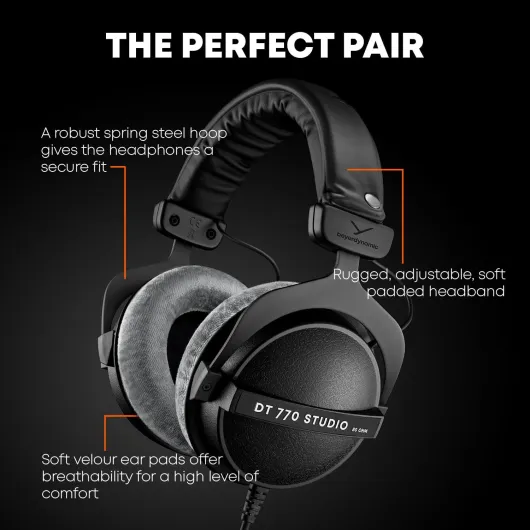
In terms of materials, the DT 770 Pro sit in that “built to last, not to impress” category. The cups are hard plastic, the headband is metal, and the padding is covered in soft velour on the earcups and synthetic leather on the band. When you pick them up, they don’t feel cheap, but they also don’t have that heavy, luxurious feel of some more expensive models. I’d call it practical and sturdy rather than premium.
The velour pads are the standout here. The fabric is soft, breathable, and doesn’t get sweaty as fast as leather or fake leather pads. After a few hours of use, I never had that sticky, hot feeling you get with many closed-back headphones. The downside is that velour doesn’t isolate quite as hard as thick pleather pads, and it can flatten out over time. The good news: these pads are easily replaceable, and there are plenty of third-party options if you want to tweak comfort or sound later.
The headband padding is decent. It’s not super thick, but combined with the overall weight of the headphones, it’s enough. I never felt a hotspot on the top of my head, even after long sessions. The band cover is also removable, so if it wears out or peels after a few years, you can swap it. That’s one of the strengths of beyerdynamic in general: most parts are serviceable, which extends the life of the product.
The weak link, again, is the cable. The rubber feels tough enough, and I didn’t have any kinks or tangles that worried me, but the fact that it’s fixed is a downside for long-term ownership. If you roll over it with your chair, catch it on a desk corner, or your cat decides it’s a toy, you’re not just replacing a cable – you may be dealing with a repair. For something marketed as a long-term studio tool, I would have liked a detachable cable system. So materials are mostly solid and thought through, but the cable choice keeps it from feeling fully future-proof.
Built to survive daily studio use, with one obvious weak point
In terms of durability, the DT 770 Pro feels like something designed for work environments, not just home listening. I’ve tossed them on the desk, accidentally bumped them off a low chair, and generally not babied them, and they still look and feel the same as day one. The headband metal doesn’t flex in a worrying way, and the plastic on the cups feels tough rather than brittle.
One of the big strengths is that most parts are replaceable. Pads wear out? You can swap them easily. Headband cushion gets old? Also replaceable. Even if you sweat on them a lot or use them daily in a shared studio, you don’t have to throw the whole thing away when the soft parts get tired. That’s a big plus compared to many consumer headphones where the pads are glued or hard to find.
The joints and sliders haven’t loosened on me. The size adjustment still has a firm click, and there’s no rattling when you move your head. The velour pads do flatten a bit with use, which is normal, but it’s more of a comfort and sound-tuning thing than a durability issue. Plan on buying new pads after a couple of years if you use them heavily – that’s just the reality of any over-ear headphone.
Again, the main risk area is the fixed cable. It’s thick and feels robust, but any fixed cable is a potential failure point over time, especially if you roll over it with a chair or yank it by accident. In a studio where people are stepping on cables and moving around, I’d be a lot more relaxed with a detachable cable system. So while the overall build and replaceable parts are a strong point, the cable design keeps the durability from being near bulletproof in real-world use.
Clear, punchy sound with good isolation, but needs proper power
Sound-wise, the DT 770 Pro 80 Ohm are pretty solid for the price, especially if you use them with decent gear. The general profile is what people call slightly V-shaped: the bass has some punch, the treble has some energy, and the mids sit a bit behind but still clear. In practice, that means kick drums, bass lines and vocals come through clearly, and there’s enough detail in the highs to pick out cymbals, reverb tails and small background sounds without feeling muddy.
For recording and monitoring, I’d say they get the job done well. When tracking vocals or guitar, I could hear timing issues, noise, and small mistakes without struggling. The isolation is good enough that click tracks and backing tracks didn’t bleed noticeably into the mic at normal levels. They’re not completely silent like active noise-cancelling headphones, but they cut out a fair amount of room noise and fan hum. On the flip side, if you blast them, some sound will leak out, but it’s much less than open-back or semi-open models.
The soundstage (the feeling of space) is decent for closed-back headphones but nothing special. You don’t get that big, open feel of the DT 880/990 or other open-back models. For gaming, positional audio is still fine – I could tell where sounds were coming from in shooters – but it’s more “inside your head” than “around you.” For music, separation is good enough that busy tracks don’t collapse into a mess, which is what you want for checking mixes or just focused listening.
One important point: the 80 Ohm version really prefers a decent source. On my audio interface, they had good volume, punchy bass and clear highs. On my phone without a dongle DAC, I had to run them near max volume and they still felt a bit flat and underpowered. If you’re mainly using a phone or a weak laptop output, you either buy a small DAC/amp or go for the 32 Ohm model. From what I’ve seen and read, you don’t lose much sound quality going down to 32 Ohm for casual use, and it’s just easier to drive.
What you actually get and how they fit into a setup
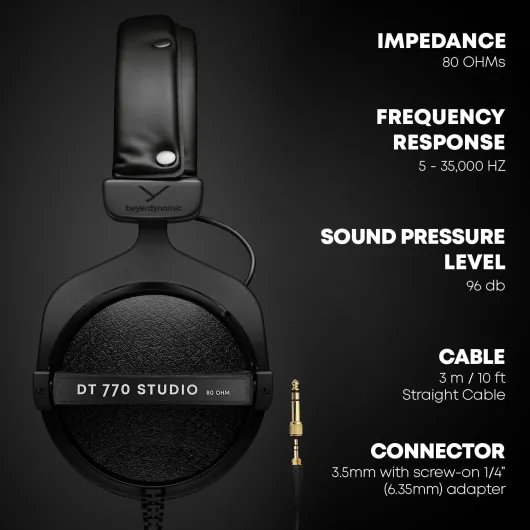
Out of the box, the DT 770 Pro 80 Ohm are pretty simple: the headphones, a long fixed cable with a 3.5 mm jack and a screw-on 1/4" adapter, plus a basic drawstring bag. That’s it. No hard case, no spare pads, no fancy accessories. For a product that’s been a studio standard for years, it feels very no-nonsense, which is fine, but don’t expect a premium unboxing moment.
The 80 Ohm version is kind of the middle child of the range. You’ve got 32 Ohm (easier to drive from phones/laptops), 80 Ohm (what I tested), and 250 Ohm (more for dedicated studio gear and headphone amps). In practice, on my audio interface and desktop PC with a half-decent headphone output, the 80 Ohm model worked well. On my phone and older laptop, I had to push the volume pretty high to get them loud enough, and sometimes it still felt a bit flat. If you plan to use them mostly on a phone without a dongle DAC or amp, I’d seriously consider the 32 Ohm instead.
These are closed-back, over-ear headphones aimed at recording, monitoring, and general studio work. That means they’re built more for isolation and honest sound than for commuting or walking around. They don’t fold, the cable is long, and they sit a bit bulky on the head. You can use them for gaming and media easily – I did – but they’re not portable in the everyday sense. On a desk, plugged into an interface, they make a lot more sense.
So in terms of role: they sit somewhere between pure studio gear and all-rounder. They’re very much at home on a mic stand or next to an audio interface. They can double as your main headphones for music and games, but if you mainly want something compact for travel or office use, the form factor and long cable are a bit annoying. As long as you go in with that expectation, they fit nicely into a home or project studio setup.
Pros
- Comfortable velour pads and light feel, good for long sessions once broken in
- Clear, punchy sound with good detail and decent isolation for recording and monitoring
- Sturdy build with many replaceable parts (pads, headband), suitable for long-term use
Cons
- Fixed, non-detachable cable that’s long and inconvenient for portable use
- 80 Ohm version needs a decent source or DAC/amp to sound its best, weak from phones
- Bulky, non-folding design and strong initial clamp make it poor for wearing around the neck or travel
Conclusion
Editor's rating
After living with the beyerdynamic DT 770 Pro 80 Ohm for a while, my take is pretty simple: they’re solid, reliable studio-style headphones that do their job well, with a few practical annoyances you should know about. The sound is clear and punchy, the isolation is good for recording and focused listening, and the comfort is one of their best points once the clamp loosens up a bit. For long sessions at a desk or in a small studio, they’re easy to recommend.
They’re not perfect, though. The fixed cable is old-fashioned and a real weak spot for long-term use. The 80 Ohm version also really wants a decent source – an audio interface, DAC, or at least a strong laptop output. Straight from a phone, they’re usable but not at their best. They also aren’t portable-friendly: no folding, long cable, and awkward around the neck. If you understand those trade-offs and mainly want something for home or studio use, the value is good and you’re getting a proven workhorse. If you need one pair that does everything, including easy mobile use, I’d look at the 32 Ohm version or a more portable design.