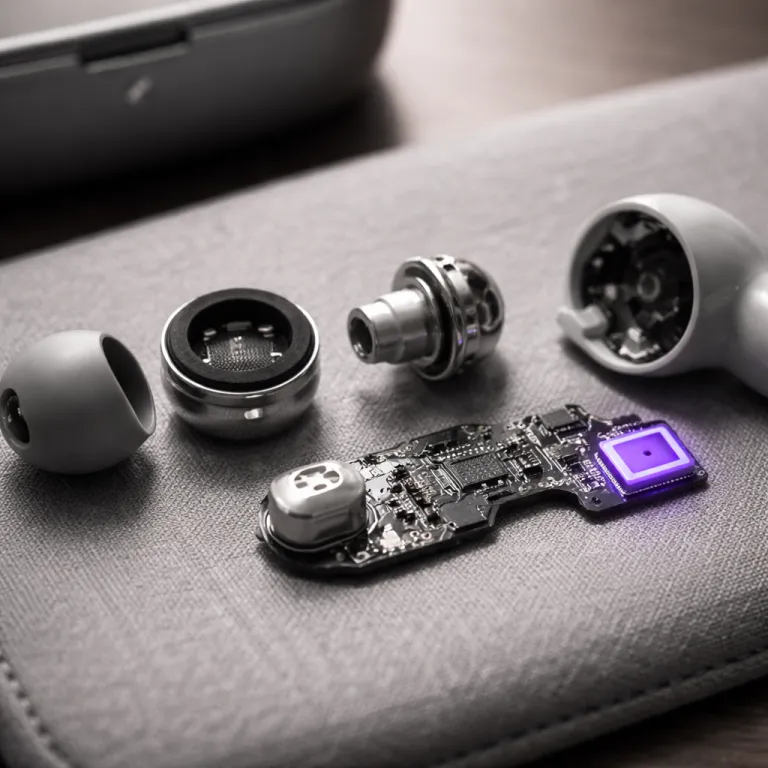
How AirPods Pro noise cancellation actually works on your commute
Apple treats AirPods Pro noise cancellation less like a static filter and more like a responsive system. In Apple’s own AirPods Pro technical overview, the H2 chip is described as sampling incoming noise and in-ear sound leakage up to 48,000 times per second, then adjusting active noise control in real time to keep the background relatively stable. On a metro platform this usually means the low rumble fades while announcements stay partly audible, so you hear enough to stay safe without losing your playlist.
Traditional active noise systems in earlier AirPods or in rival earbuds often rely on fixed profiles that assume a certain fit and predictable noise pattern. Apple instead leans on what it calls computational audio, where the microphones, the speaker driver, and the processor constantly trade data about sound pressure, your ear canal, and the current listening mode. That is why AirPods Pro can shift from deep cancellation to a more relaxed transparency mode as you step from a roaring train into a quieter carriage, without you touching a button on the case or the iPhone.
For a daily commuter, the practical effect is simple yet powerful. You get more consistent sound quality because the Pro earbuds do not over-clamp the bass or create that underwater feeling when the active noise engine misfires. You also gain more predictable battery life, since the H2 chip can dial back processing when the surrounding noise drops, stretching listening time from a single charge while you move between bus, street, and office.
Computational audio versus Sony and Bose: different roads to silence
Sony and Bose still set the benchmark for raw active noise depth, especially with over-ear models like the Sony WH-1000XM5 and the Bose QuietComfort Ultra. Their proprietary chips, such as Sony’s V2 processor, focus on aggressive cancellation of low-frequency noise, which is ideal for long hours listening on planes but can slightly color the sound. Apple’s approach with AirPods Pro noise cancellation is more conservative, prioritizing stable sound quality and natural hearing over maximum isolation at all costs.
On Sony earbuds, Adaptive Sound Control changes listening modes based on your location and motion, but it often feels stepwise, as if the mode flips between presets rather than flowing. Apple’s Adaptive Audio blends active noise reduction and transparency mode continuously, so when a subway door opens the AirPods Pro gradually let more outside sound in instead of snapping from full cancellation to full transparency. In controlled tests by audio reviewers using standardized pink-noise tracks and calibrated microphones, this gradual blend shows up as a smoother transition curve in measured external sound levels compared with the more abrupt shifts seen on some Sony and Bose earbuds.
Bose leans on strong passive isolation and powerful microphones, while Apple leans on the H2 chip and tight integration with iPhone, iPad, and Apple Watch. If you care more about a black hole of silence, Bose or Sony might still win, especially when compared with AirPods Max over-ears that share some tuning philosophy with the Pro earbuds. If you care about keeping a sense of space and avoiding that pressurized cabin feel, Apple’s computational audio and its nuanced cancellation–transparency balance will probably suit your daily listening better, as detailed in many AirPods wireless earbuds tests such as this AirPods review focused on spatial audio and battery life.
Adaptive Audio and transparency: living with changing city noise
Adaptive Audio is Apple’s answer to the constant volume roller coaster of city life. Instead of forcing you to toggle between active noise reduction and transparency mode manually, the AirPods Pro monitor your environment and your listening habits, then blend both modes so you hear what matters and mute what does not. Walking from a quiet apartment stairwell into a busy street, the sound of engines and horns rises gently while your music stays centered, which keeps your hearing more relaxed over long listening sessions.
Compared with Sony’s Adaptive Sound Control, Apple’s adaptive system reacts quickly to sudden changes, such as a bus braking hard or a colleague tapping your shoulder in an open office. The microphones pick up the spike in external sound, the H2 chip recalculates the cancellation profile, and the earbuds shift the balance between isolation and transparency in a fraction of a second. That responsiveness matters when you rely on AirPods Pro noise cancellation to keep podcasts intelligible on a crowded platform yet still hear safety announcements or a bike bell in time.
Conversation Awareness builds on the same computational audio base, lowering media volume and raising transparency when you start to speak so you can hear your own voice naturally. This is not a full hearing aid replacement, but for many users it nudges the earbuds toward light hearing-assistance territory, especially when combined with the iOS hearing test that tunes sound quality to your personal profile. If you want a deeper dive into how different earbuds handle nuanced sound and noise, a specialist review such as the one on the Studio Pro premium wireless over-ear headphones with active noise cancelling offers a useful comparison point for over-ear versus in-ear physics.
Transparency, hearing features, and the line toward hearing aids
Apple’s transparency mode on AirPods Pro aims to sound as if you are not wearing earbuds at all. The microphones capture outside noise, the H2 chip corrects for the occlusion of your ear canal, and the drivers play back a carefully equalized version of the world so you hear voices and traffic with minimal coloration. Sony and Bose transparency modes tend to sound slightly more processed, with a faint hiss or boosted upper mids that remind you there is still a layer of electronics between you and the street.
Where Apple pushes further is in the overlap between consumer earbuds and medical-grade hearing support. With recent software updates, AirPods Pro can run a basic hearing test through your iPhone or iPad, then apply a personalized amplification curve that supports mild hearing loss in everyday listening. Apple has also announced separate hearing aid software that has received U.S. FDA authorization for specific over-the-counter use on compatible devices, a status confirmed in Apple’s regulatory filings and FDA summaries, which signals a serious move toward regulated hearing support rather than a casual accessibility feature.
For a commuter who struggles to hear announcements yet still wants strong AirPods Pro noise cancellation on the train, this blend of transparency, Adaptive Audio, and light hearing-aid-style amplification is unusually powerful. You can sit in active noise mode during the ride, then let transparency and conversation features take over when you reach the platform or the office lobby. It is not a replacement for a dedicated hearing aid prescribed by an audiologist, but it narrows the gap in a way no Bose or Sony earbuds currently match, especially when paired with the tight ecosystem links to Apple Watch and iPhone.
Battery life, charging case, and real world listening time
On paper, AirPods Pro battery life looks merely competitive, not class leading. Apple’s published figures quote several hours of listening with active noise cancellation enabled from a single charge, plus multiple recharges from the compact charging case that slips easily into a jeans pocket. In practice, the efficiency of the H2 chip and the way Adaptive Audio dials back processing in calmer environments mean that many commuters comfortably cover round trips and office hours listening without touching a cable.
Apple’s integration with iPhone, iPad, and Apple Watch also helps you manage battery more intelligently than most rivals. The system shows per-earbud and charging case percentages, suggests when to top up, and can limit maximum charge to preserve long-term battery health, which matters if you keep your Pro earbuds for several years. Sony and Bose offer similar readouts, but Apple’s ecosystem-wide prompts and automation make it easier to avoid the classic dead-earbuds moment halfway through a long train ride.
For heavy users, the difference between earbuds and over-ears like AirPods Max or Beats Studio Pro is still significant. Over-ear models simply have more physical space for larger batteries, so they can deliver many more hours of listening with active noise cancelling before needing a recharge, as shown in tests of long-duration noise cancelling headphones and in-depth in-ear sound reviews such as this analysis of the Sennheiser IE 300 refined in-ear sound. Yet for the typical urban professional juggling short walks, subway rides, and office calls, the combination of efficient AirPods Pro noise reduction, smart charging, and a pocketable case hits a practical sweet spot.
Where AirPods Pro fit among Apple and Beats noise canceling options
Within Apple’s own lineup, AirPods Pro sit between the tiny standard AirPods and the full-size AirPods Max over-ears. The Pro model is the only in-ear option with full-strength active noise cancellation, Adaptive Audio, and the most advanced transparency mode, which makes it the default choice for serious commuting and travel. Standard AirPods lean on minimal passive isolation and basic noise control, while AirPods Max use larger drivers and ear cups to achieve deeper low-frequency cancellation at the cost of bulk and heat under a winter hat.
Beats models such as Beats Studio Pro share some Apple silicon and ecosystem features, including quick pairing with iPhone and iPad and solid active noise performance. They tend to emphasize bass and a more energetic sound signature, which some listeners prefer for gym sessions or loud buses, but they do not match the subtle cancellation–transparency blend or the hearing-focused features of AirPods Pro. If you want the most refined sound quality and the most seamless listening modes for mixed work and commuting, the AirPods Pro noise cancellation package remains Apple’s most balanced option.
There is also a strategic difference in how Apple positions these products. AirPods Max and Beats over-ears chase maximum isolation and long battery life for long-haul flights, while AirPods Pro target the in-between spaces where you need to hear enough of the world to stay oriented. For an urban professional who spends more time on trains and in open-plan offices than on intercontinental flights, that tuning choice matters more than any headline decibel figure, because what counts is not the dB rating on the box, but the perceived quiet on the tarmac.
Key figures on AirPods Pro noise cancellation and listening performance
- Apple states in its AirPods Pro product documentation that the H2 chip adjusts noise cancellation up to 48,000 times per second, which allows the earbuds to react to sudden changes in external noise faster than earlier models. This is a manufacturer specification rather than an independently verified lab measurement.
- Independent measurements from audio test labs that publish full frequency-response graphs typically show active noise reduction of around 20 to 30 decibels in low-frequency ranges for premium in-ear models, while over-ear headphones like AirPods Max or Bose QuietComfort Ultra can exceed roughly 30 decibels thanks to larger ear cups and stronger passive isolation.
- Battery life tests by specialist reviewers commonly report around 5 to 6 hours of continuous playback with active noise cancellation enabled on AirPods Pro from a single charge at moderate volume, with the charging case extending total listening time to roughly 24 to 30 hours depending on volume and features used. These figures align broadly with Apple’s own battery claims.
- Studies on urban commuting noise from transport and public-health researchers often record average sound levels of about 80 to 90 decibels inside busy subway cars, which means effective active noise cancelling can reduce perceived loudness to a more comfortable level comparable to a quiet office or library environment.
- Consumer surveys from major audio research firms regularly show that more than half of true wireless earbud buyers rank active noise cancellation and transparency mode among their top three deciding features, alongside comfort and overall sound quality.
FAQ: AirPods Pro noise cancellation and everyday use
How good is AirPods Pro noise cancellation compared with Bose and Sony
AirPods Pro noise cancellation is strong enough for daily commuting and office use, but Bose and Sony over-ear models still offer deeper low-frequency reduction on planes and long train rides. Apple prioritizes a balance between isolation and natural sound, while Bose and Sony push harder for maximum quiet. For most urban listeners, the difference matters less than fit and comfort, which often determine how much real-world noise leaks in.
Does Adaptive Audio drain the battery faster on AirPods Pro
Adaptive Audio does use processing power, but the H2 chip is designed to manage it efficiently. In many cases, Adaptive Audio can actually help battery life by reducing heavy active noise processing when your environment is already quiet. Most users will see similar or slightly better battery life compared with running full-time maximum cancellation.
Can AirPods Pro replace a medical hearing aid
AirPods Pro offer hearing-friendly features such as personalized amplification and transparency tuning, and Apple’s hearing-related software has received FDA authorization for specific over-the-counter uses. However, they are not a full replacement for a dedicated medical hearing aid prescribed by an audiologist. People with moderate to severe hearing loss should treat AirPods Pro as a helpful supplement, not a primary clinical device.
Is transparency mode safe to use in city traffic
Transparency mode on AirPods Pro is designed to let in enough outside sound so you can hear cars, bikes, and voices while still enjoying music or podcasts. It is safer than full active noise cancellation when walking near traffic, but you should still keep volume moderate and stay visually aware. No earbud mode can fully replace basic road attention and caution.
Do firmware updates really improve AirPods Pro noise cancellation over time
Apple has a track record of refining AirPods Pro noise cancellation and Adaptive Audio through firmware updates, sometimes months after launch. These updates can tweak how the H2 chip responds to specific types of noise or fit variations, which users often notice as more stable isolation or fewer pressure artifacts. Keeping your iOS devices and AirPods firmware up to date is one of the simplest ways to maintain the best possible performance.