
Summary
Editor's rating
Is it worth the money or just a fancy toy?
Small, simple, and a bit fiddly at first
Battery life and charging: no big drama here
Everyday comfort and real-world usability
Build quality and how sturdy it feels
Tone and effects: good for practice, not magic
What it actually is (and what it’s not)
Pros
- Very quick and simple silent practice setup with just guitar + headphones
- Good range of usable amp models and effects for the size
- Bluetooth audio and solid battery life make it handy for jamming with backing tracks
Cons
- Color-based controls are not very intuitive and take time to learn
- Plastic build and rotating jack need some care, not ideal for rough handling
- Clean and edge-of-breakup tones are decent but not as lively as real tube amps

Specifications
View full product page →| Brand | Fender |
Silent practice without driving everyone mad
I’ve been using the Fender Mustang Micro for home practice for a while now, mainly because my regular amps are just too loud for late evenings and apartment life. I’m not a studio engineer, just a regular guitarist who wants decent tone in headphones without setting up half the living room. I bought this to see if a tiny plastic dongle could really replace dragging out a Katana or tube combo just to run scales and jam with YouTube.
In practice, the idea is simple: plug this thing straight into the guitar, plug headphones into it, pick an amp model, and you’re off. No cables on the floor, no power strip, no pedalboard. That’s the main reason I kept reaching for it after the first week – it’s just stupidly quick. If I have ten spare minutes, I’m playing instead of fiddling with gear.
Going in, I expected it to sound a bit cheap and toy-like, because most headphone amps I’ve tried felt like that. This one is clearly better than the typical pocket amps you find for half the price. It’s still digital, it still has limits, but for practicing and learning songs it does the job well. Clean tones are decent, high-gain tones are actually pretty fun, and the effects are more useful than I expected on such a small box.
It’s not perfect though. The controls are a bit cryptic at first, there’s no screen, and you have to remember which color means which amp or effect. Also, if you hate digital amp sounds in general, this won’t magically change your mind. But if your goal is quiet practice with backing tracks and minimal hassle, it hits that target pretty solidly. That’s the context I’ll stick to in this review: not "studio-grade tone", just honest, everyday use.
Is it worth the money or just a fancy toy?
Price-wise, the Mustang Micro sits above the really cheap headphone amps, but well below full-blown multi-effects units and serious modelers. For what you pay, you’re getting decent tones, Bluetooth backing tracks, USB-C, and a rechargeable battery in a very small package. Compared to using something like a Boss Katana just for headphone practice, it feels like a more practical solution if you’re short on space or don’t want to set up an amp every time.
There are cheaper options on the market, but most of them either sound noticeably worse or don’t have Bluetooth and the same range of amp models. What you’re really paying for here is convenience plus a sound quality that’s good enough that you don’t feel like you’re playing through a toy. If you’re the kind of player who practices a lot at night or in shared spaces, the extra cost starts to make sense because you’ll actually use it often. It’s the kind of device that ends up living in your gig bag or on your desk and gets used way more than you expect.
On the other hand, if you already own a proper audio interface and use amp sims on a computer, this might overlap with what you have. A laptop with plugins will give you better editing and possibly better overall tone. The trade-off is that it’s slower to set up and ties you to a desk. So value really depends on your habits: if you want to be able to plug into a guitar anywhere in the house and just go, the Mustang Micro feels like good value. If you’re mostly a desk player with a DAW, it’s more of a luxury than a necessity.
Personally, I’d call it good value for money for people who genuinely need silent practice on a regular basis. It’s not the cheapest route, but it strikes a nice balance between sound quality, features, and ease of use. If you only play occasionally and already have a small practice amp with a headphone out, it might be overkill. But for frequent, low-hassle practice, the cost is pretty easy to justify.
Small, simple, and a bit fiddly at first
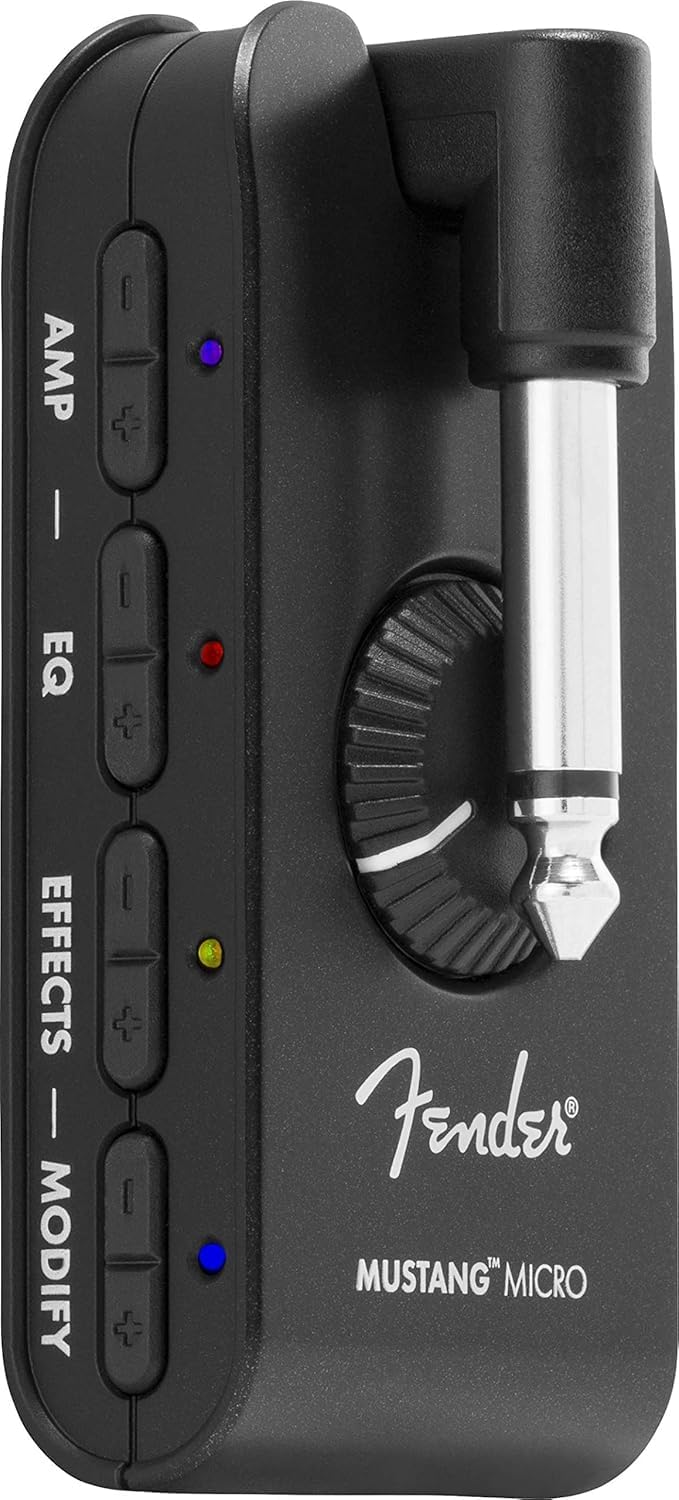
Design-wise, the Mustang Micro is very straightforward: small black plastic body, a rotating 1/4" jack, and a few buttons on top with colored LEDs. There’s no screen, which keeps it compact but also means you have to learn what each color represents. At the beginning, I found myself checking the manual or a cheat sheet to remember which color was which amp model or effect. After a few days of using the same 3–4 sounds, it became less of a problem, but it’s not exactly intuitive on day one.
The rotating jack is actually one of the smartest parts of the design. On some guitars, like Strats or Teles, you just plug it in and tilt it slightly up or down so it doesn’t hit anything. On guitars with side jacks or weird placements, you might have to experiment a bit. On one of my guitars with a slightly loose jack, I had the same issue as one of the Amazon reviewers: it didn’t feel totally snug at first and I got some crackling until I fixed the guitar’s own connector. So if you hear static, check your guitar jack before blaming the Mustang Micro.
Button layout is simple: amp select, effects, EQ, modify, plus volume up/down. The LEDs change color to show what you’re on. It’s functional but not very "discoverable". You won’t be scrolling through presets by name, you’re just cycling through colors. For a live situation that would be annoying, but for home practice I ended up picking a few favorites and sticking with them. It’s a trade-off: tiny size and no screen means less clarity, but it also means it fits in any pocket or gig bag.
In terms of everyday use, the design is clearly focused on convenience. It turns on fast, it doesn’t need a wall socket, and it doesn’t clutter your space. If you like gear with lots of knobs and visual feedback, you might find it a bit bare-bones. If you just want "plug in, pick a sound, play", the design supports that pretty well, once you get used to the color system.
Battery life and charging: no big drama here
The Mustang Micro runs on a built-in lithium battery and charges via USB-C, which is a relief compared to older gear that still uses micro-USB or random proprietary plugs. In actual use, the battery life is good enough that I stopped thinking about it much. Fender quotes several hours, and that lines up with what I’ve seen. For me, doing 30–60 minute sessions most days, I was only plugging it in every few days.
One useful detail: you can use it while charging. That means even if you forget to charge and it’s low when you want to practice, you can just hook it to a USB charger or a power bank and keep going. There’s no noisy hum introduced by the charging cable in my experience, at least not with the chargers I used. It behaves more like a small USB audio device than a traditional amp in that sense.
I didn’t sit there with a stopwatch, but during longer sessions of two to three hours with Bluetooth backing tracks active, it held up without suddenly dying. If you crank volume and use Bluetooth constantly, expect the battery to drain faster, obviously. But for normal home use, it’s not a unit you’ll be charging daily unless you’re playing for several hours every single day.
The only mild annoyance is that there’s no big, clear battery percentage indicator. You get basic feedback from the LED, but it’s not super precise. So you kind of learn to plug it in every few days as a habit instead of waiting for it to warn you. Overall, for a tiny device, the battery situation is pretty practical: USB-C, decent runtime, and usable while charging. No big complaints here.

Everyday comfort and real-world usability
Comfort with this kind of product is less about soft cushions and more about how annoying it is to use day after day. On that front, the Mustang Micro is actually pretty convenient. The biggest plus is cable reduction: you’ve got the unit on the guitar and a single headphone cable. Compared to my usual setup with an amp, a long guitar cable, sometimes a pedalboard, and another cable to headphones or a load box, this feels much lighter. For quick practice before bed, that makes a real difference.
Physically, once you rotate the jack to a good angle, the unit doesn’t really get in the way. On my Strat, I angle it slightly up and it sits close to the body without poking my leg when I sit. On a Les Paul-style guitar with a side jack, I needed to experiment, but I eventually found a position where it didn’t feel like it was about to snap off. If your guitar jack is already wobbly, fix that first, because any movement there will translate into crackles and general annoyance.
Using the controls while playing is okay but not ideal. Since there’s no screen, you end up memorizing color codes and pressing buttons to cycle through options. Changing amp types mid-song isn’t very practical; I mostly set it before I start and leave it. For comfort, that’s fine – I’m not stepping on pedals, I just commit to a sound for a practice session. If you like to constantly tweak, you might find this a bit limiting and slightly fiddly, especially in low light.
On the headphone side, it depends a lot on what you plug in. With decent over-ear or in-ear headphones, the sound is more than good enough and you can keep the volume at a comfortable level. Cheap earbuds work, but they flatten the tone a bit. In daily use, I found myself picking up the Mustang Micro more often simply because the friction to start playing was so low. That, for me, is the biggest comfort factor: I actually play more, even if the interface isn’t perfect.
Build quality and how sturdy it feels
The Mustang Micro is mostly plastic, and you can feel that right away. It’s not some heavy metal brick. That said, it doesn’t feel like it’s going to fall apart the first time you drop it either. The plastic casing is fairly rigid, and the main thing you end up testing over time is the rotating jack and the buttons. On my unit, the jack hinge feels reasonably firm – it holds its position and doesn’t flop around – but I still wouldn’t treat it like a tank. If you’re rough with your gear or throw guitars into cases without thinking, I’d be a bit careful.
The buttons have a simple clicky feel and haven’t given me issues so far. They don’t feel premium, but they also don’t feel like the kind that will wear out in a month. The LED windows are clear enough to see the colors even in daylight. If anything is going to wear, it’s probably the jack and the internal battery over a few years, like most small electronics. The good news is that users have been buying this since 2021 and it’s still going strong in the rankings, which usually means it’s not dying on people left and right.
I wouldn’t recommend leaving it permanently plugged into a guitar that sits in a gig bag or hard case, because a sideways hit could put stress on the guitar jack or the Mustang Micro’s rotating joint. I got into the habit of unplugging it when I’m done and tossing it into a small pouch. It’s tiny, so that’s not a big ask. For home use, normal care is enough: don’t step on it, don’t twist it like crazy, and don’t yank the headphones out by the cable.
Overall, for a plastic unit at this price, durability feels acceptable. It’s not built like an indestructible pedal, but if you treat it as a small electronic device instead of a hammer, it should last. The 2-year warranty is also a bit reassuring: if there’s an early failure, you’re covered. Just don’t expect it to survive the same abuse as a metal stompbox or a road case.
Tone and effects: good for practice, not magic
Let’s talk about how it actually sounds. Overall, I’d say the Mustang Micro is pretty solid for headphone practice, especially if you like higher-gain stuff or modern clean tones. There are multiple amp models taken from the bigger Mustang amps: Fender-style cleans, some British-style crunch, higher-gain modern amps, and a few more. The cleans are usable and clear enough for practice, but if you own real Fender tube amps, you’ll notice they don’t have the same depth or breakup. One Amazon reviewer nailed it: the blackface-style models could use more character. They’re fine, just not very inspiring if you’re picky.
Where it does better is high-gain and driven tones. The saturated sounds are tight and fun to play with, especially through decent headphones. Palm mutes and riffs come through with good clarity, and the noise level stays under control if you don’t push the gain to the absolute max. It’s not at the level of a high-end modeler, but for a pocket unit running off a tiny battery, it’s more than enough to keep practice interesting. I ended up spending more time on the mid-gain and high-gain settings than I expected.
The effects are basic but useful: different combinations of reverb, delay, modulation, etc. You don’t get deep editing, but the modify button lets you shift the character enough to avoid everything sounding the same. For example, you can move from a short room reverb to a longer, more spacious one, or adjust delay feedback. It’s still limited, but for practice and jamming with backing tracks, I didn’t really miss the fine-tuning. If you’re used to building complex pedalboards, this will feel like a simplified taste of that world.
Latency over Bluetooth for backing tracks is handled pretty well. I used it with YouTube lessons and songs on my phone, and the sync felt good enough to play along without feeling off. Just keep in mind: Bluetooth is only for the backing audio, your guitar signal is wired straight to the headphones, so there’s no weird delay on your playing. Overall, for what it’s meant to do – silent practice with varied tones – the performance is good. I wouldn’t use it as my main recording rig, but for day-to-day playing, it does the job without fuss.
What it actually is (and what it’s not)
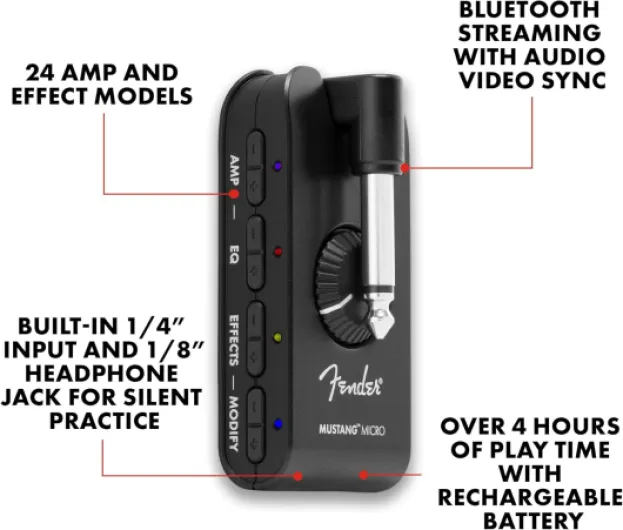
The Fender Mustang Micro is basically a tiny 5W digital amp with built-in effects that plugs directly into your guitar’s jack. No speaker, no separate power supply needed, just a rechargeable battery and a headphone output. You get several amp models (clean, crunch, high gain, etc.) and a selection of effects like reverb, delay, chorus, and so on. Everything is driven by onboard DSP, and you control it with a handful of buttons on the unit. There’s also Bluetooth audio, but that’s only for streaming backing tracks or YouTube – not for sending your guitar sound out.
The unit is roughly the size of a small matchbox charger: about 6.25 x 6.25 x 2.1 inches in the official specs, but in the hand it feels smaller and much lighter than you’d expect. It weighs a couple of ounces, so once it’s plugged into the guitar, you mostly forget it’s there. The jack rotates, which is important because it lets you angle the unit so it doesn’t dig into your leg or bump the guitar body too much. That hinge feels like the main mechanical piece you end up trusting over time.
On the control side, you’ve got separate buttons for amp models, effects, EQ, and a modify button to tweak parameters. No detailed editing like on a full Mustang GTX or a computer plugin, but enough to switch character quickly. You also get volume and a USB-C port for charging and using it as an audio interface with a computer. So on paper, it’s clearly aimed at practice, learning songs, and maybe very basic recording or demo work.
Just to be clear: this is not a replacement for a real amp on stage, and I wouldn’t buy it as my "main tone" solution. Think of it as a practice tool first. If you go in with that mindset – quiet practice, jamming with your phone, learning parts without annoying the neighbors – the feature set makes sense. If you expect it to behave like a full-on modeler with deep editing and stereo effects, you’ll probably be a bit let down.
Pros
- Very quick and simple silent practice setup with just guitar + headphones
- Good range of usable amp models and effects for the size
- Bluetooth audio and solid battery life make it handy for jamming with backing tracks
Cons
- Color-based controls are not very intuitive and take time to learn
- Plastic build and rotating jack need some care, not ideal for rough handling
- Clean and edge-of-breakup tones are decent but not as lively as real tube amps
Conclusion
Editor's rating
The Fender Mustang Micro is a very practical tool if your main goal is quiet guitar practice with decent tone and minimal setup. It plugs straight into the guitar, works with any normal headphones, and gives you a nice spread of amp models and effects. Clean tones are decent, driven and high-gain tones are actually quite fun, and the Bluetooth backing track feature makes it easy to jam along with YouTube or playlists. Battery life is solid, USB-C charging is convenient, and the whole thing is so small that you can keep it in a pocket or gig bag without thinking about it.
It’s not perfect. The all-plastic build and rotating jack mean you should treat it with a bit of care, the color-coded interface is not very intuitive at first, and if you’re picky about authentic tube amp feel, the digital sound will only get you so far. For serious recording or for someone who already has a full modeling setup on a computer, it might feel a bit redundant. But for everyday players, especially those in apartments or shared spaces, it hits a very practical sweet spot.
If you’re a beginner looking for an easy way to practice without annoying anyone, or an experienced player who wants a quick plug-and-play solution for learning songs and warming up, it’s a solid buy. If you mainly play loud through real amps, hate digital tones, or already have a good interface and software rig, you can probably skip it. In short: it’s not magic, but it gets the job done very well for what it’s designed to do.